<?xml version="1.0" encoding="UTF-8"?>
<?xml-stylesheet type="text/xsl" href="/stylesheets/feed.atom.xml" media="screen"?>
<feed xml:lang="en-US" xmlns="http://www.w3.org/2005/Atom">
  <id>tag:irishstudies.nd.edu,2005:/news</id>
  <link rel="alternate" type="text/html" href="https://irishstudies.nd.edu"/>
  <link rel="self" type="application/atom+xml" href="https://irishstudies.nd.edu/news.atom"/>
  <id>tag:irishstudies.nd.edu,2005:/latest</id>
  <title>Keough-Naughton Institute for Irish Studies | News</title>
  <updated>2026-08-18T23:59:00-04:00</updated>
  <link rel="alternate" type="text/html" href="https://irishstudies.nd.edu/"/>
  <link rel="self" type="application/atom+xml" href="https://irishstudies.nd.edu//news.atom"/>
  <subtitle>The Keough-Naughton Institute for Irish Studies is a teaching-and-research institute dedicated to the study and understanding of Irish culture — on the island of Ireland and around the world.</subtitle>
  <entry>
    <id>tag:irishstudies.nd.edu,2005:News/184901</id>
    <published>2026-08-18T23:59:00-04:00</published>
    <updated>2026-08-19T11:50:38-04:00</updated>
    <link rel="alternate" type="text/html" href="https://irishstudies.nd.edu/news/macgill-summer-school-2026-the-new-world-disorder/"/>
    <title>MacGill Summer School 2026: The New World Disorder</title>
    <summary type="text">
      <![CDATA[The three-day forum, co-organized by the University of Notre Dame’s Keough-Naughton Institute, has become a premier space for discussing and hearing about new ideas on the island of Ireland.]]>
    </summary>
    <content type="html">
      <![CDATA[<p class="lede">As Vince McCarthy opened the 2026 MacGill Summer School, he began with remarks about the late Dr. Joe Mulholland’s founding mission: to create a space for long-term thinking for the country.</p>
<p>MacGill was designed to be a space for new ideas, bringing together thoughtful people who would challenge conventional thinking outside of the Dublin bubble. The Keough-Naughton Institute for Irish Studies, part of the University of Notre Dame’s Keough School of Global Affairs, came on board as co-organizer five years ago and brought new life and perspectives which have further sharpened and enhanced this undertaking. Over the course of the weekend, July 23-25, the 45 speakers who joined in conversation with a broad, public audience on the theme of “The New World Disorder” certainly fulfilled this mission.</p>
<p>The value of MacGill for such “long-term thinking” cannot be understated. As a forum to listen, learn and discuss, it is unparalleled in the exchanges it enables. Through the formal sessions and Q&amp;As but also through the conversations in the coffee queue, the chit chat at dinner or in Roddy’s bar after a long day. The mixing of academics, leading practitioners, politicians and members of the public for three days in the beautiful setting of Glenties, Co. Donegal, facilitates conversations covering a broad spectrum. In doing so, it offers fresh perspectives and encourages participants and attendees to reconsider familiar subjects armed with new insights and informed by the rich discussions of the day.</p>
<figure class="image image-default"><img src="https://irishstudies.nd.edu/assets/674308/fullsize/macgill_2026_collage.jpg" alt="Event panels: Women smile taking a selfie with a green hijab, a man in blue speaks with a mic, and diverse attendees converse." width="1200" height="800">
<figcaption>Audience interaction and conversations beyond the stage are essential parts of the MacGill Summer School. (Photos by Johnny Bambury)</figcaption>
</figure>
<p>This year’s opening panel was a particular highlight. The panel challenged the idea that current geopolitical tensions are the result of a temporary period of instability, arguing that we are living through a period of deep transformation. This transformation is driven by technology, shifting global power dynamics, war, economic interdependence and the growing pressures facing democracy. Professor Brigid Laffan, journalist Niall Stanage, British Ambassador to Ireland H.E. Kara Owen CMG and economist Dan O’Brien discussed how Ireland, and Europe, should respond to this change.</p>
<figure class="image image-right"><img src="https://irishstudies.nd.edu/assets/674293/macgill_26_0066.jpg" alt="Panel at MacGill Summer School 2026, associated with Notre Dame. Speaker at podium, four panelists, and large audience." width="600" height="400">
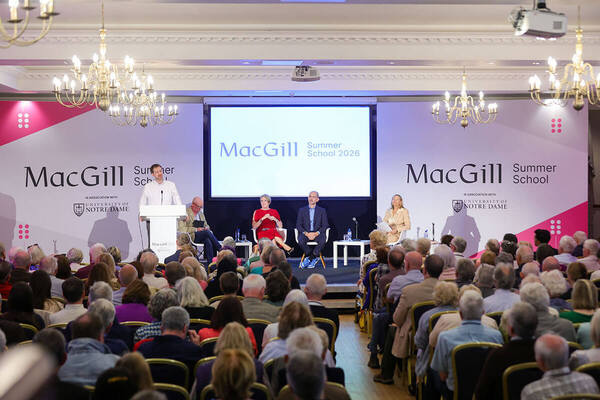
<figcaption>Vince McCarthy, director of the MacGill Summer School, welcomes a large audience to The Highlands Hotel on July 23 in the small town of Glenties, Co. Donegal.</figcaption>
</figure>
<p>For Stanage, the White House correspondent for The Hill, the American dimension was particularly concerning. He focused on unpredictability, attacks on institutions and an erosion of the normal rules of political and economic life which he argues are creating uncertainty both inside the United States and internationally. He asked whether the US can withstand these current pressures. On the final day of the conference, Robert Schmuhl, an emeritus professor of American studies and journalism at Notre Dame, returned to this subject through discussion of evolutions in US foreign policy and its changing relationships with its historical allies.</p>
<p>Owen, while approaching from the European perspective, similarly argued that greater resilience is needed. On the topic of defense, which became a key focus over the weekend, she reiterated that cybersecurity, energy supplies, technology, infrastructure and the ability of businesses and citizens to withstand disruption must all be considered part of national security. She stated that countries must aim to preserve their relationships with one another, while adapting them to a changing international context. O’Brien, chief economist for the Institute of International and European Affairs, echoed these sentiments, outlining that security needs to become a much greater priority for Ireland. The panel felt that priorities should include building resilient energy and supply chains, keeping trusted international partnerships alive and improving how Ireland adapts to technological and geopolitical change. They concurred that the future does not have to be defined by disorder, but Ireland and other countries have to adapt to new forms of stability.</p>
<figure class="image image-right"><img src="https://irishstudies.nd.edu/assets/674292/macgill_26_0220.jpg" alt="Man in a purple suit speaks into microphone, gesturing, at MacGill Summer School, in association with University of Notre Dame." width="600" height="400">
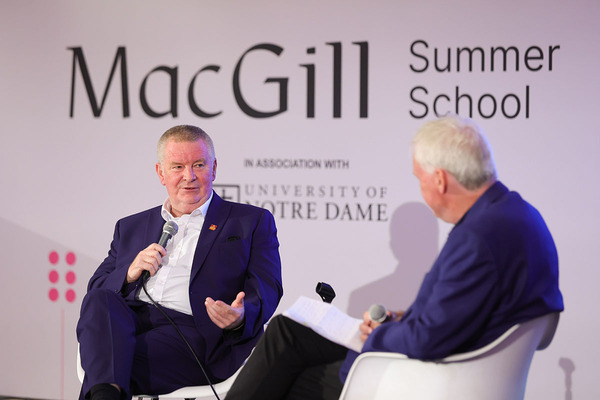
<figcaption>Dr. Mike Ryan, former executive director of the World Health Organization, delivers the Hume Lecture chaired by Luke O’Neill, professor and chair of biochemistry at Trinity College Dublin.</figcaption>
</figure>
<p>Another standout panel was the Hume Lecture given by Dr. Mike Ryan, former executive director of the World Health Organization, and chaired by Professor Luke O’Neill of Trinity College Dublin. This panel brought together perspectives from science, international diplomacy and public policy. The discussion ranged from the lessons of the COVID-19 pandemic to artificial intelligence, the future of medicine, Ireland's international reputation and the responsibilities that come with technological power.</p>
<p>Ryan emphasized that during COVID, some governments waited too long to act because they were uncertain about what the evidence would eventually show. By the time action was taken, hospitals were overwhelmed and much more disruptive measures became necessary. For him, the lesson is not that governments should act recklessly but that crisis management often requires decisions to be made without certainty. This panel reiterated a similar message to the opening discussion: Ireland must center courage and adaptability to harness its potential. The audience applauded Ryan with a standing ovation, demonstrating the popularity of his frank assessment: in an uncertain world, the ability to adapt may be more valuable than the ability to predict.</p>
<figure class="image image-right"><img src="https://irishstudies.nd.edu/assets/674290/macgill_26_1463.jpg" alt="Four panelists on stage at the MacGill Summer School, associated with Notre Dame. Man in brown jacket speaks, gesturing." width="600" height="400">
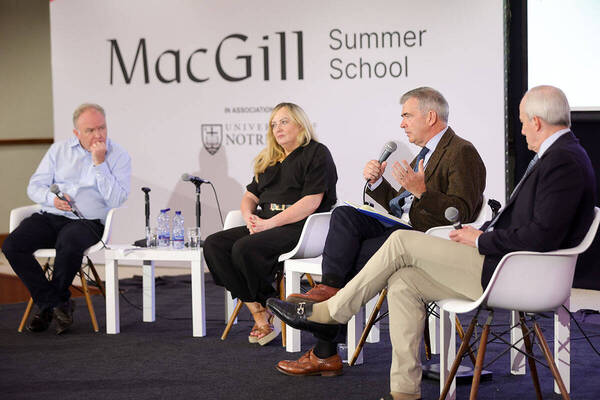
<figcaption>Drew Harris, former commissioner of An Garda Síochána, speaks during a panel discussion on organized crime.</figcaption>
</figure>
<p>The discussion on organized crime with journalist and author Barry Cummins, former Commissioner of An Garda Síochána Drew Harris, former White House and US Department of the Treasury official Greg Gatjanis and Belfast Telegraph crime correspondent Allison Morris offered fascinating and informative perspectives on a topic less well covered over the Summer School. The panel explored how crime is no longer simply a local problem, confined by borders or traditional gang structures. It has evolved into a sophisticated, international threat. The panelists argued that, as a result, policing must evolve with it.</p>
<p>At the center of the discussion was the Kinahan Organised Crime Group and the international response that led to US financial sanctions in 2022. Gatjanis, drawing on his experience with the US Department of the Treasury, explained how what appeared at first to be an Irish criminal matter was revealed to him to be an organization whose influence, wealth and violence demanded an international response. The panel also highlighted how criminal networks can exploit technology. The EncroChat breach provided law enforcement with unprecedented insight into criminal communications, revealing plans for drug deals and murders, and demonstrating how little significance national borders have for organized crime. The panel discussed how drug trafficking fuels violence and paramilitary activity and how vulnerable people can become trapped through drug debts, intimidation and exploitation. This conversation emphasized that these consequences can often be hidden from public view. Perhaps the most important message was that organized crime itself has changed. Rather than operating as rigid, vertically structured organizations, modern criminal networks are increasingly decentralized, flexible and willing to form temporary alliances across borders.</p>
<figure class="image image-default"><img src="https://irishstudies.nd.edu/assets/674291/fullsize/macgill_26_0906.jpg" alt="Four individuals on stage: two women, two men, with papers, speaking and listening around a white table. An audience watches." width="1200" height="800">
<figcaption>Actors perform Colin Murphy’s <em>The Weak Suffer What They Must</em>, an adaptation of Thucydides’ Melian Dialogue.</figcaption>
</figure>
<p>MacGill 2026 also included a return to more creative programming, with a performance from Colin Murphy’s <em>The Weak Suffer What They Must</em>. This adaptation of Thucydides’ Melian Dialogue enabled audiences to reflect on the ancient roots of “realist” foreign policy. The discussion that followed saw journalist Sarah Carey moderate a panel with Laffan, Ryan, former Teachta Dála Cathal Berry, and <a href="https://irishstudies.nd.edu/core-identity/director-and-staff/prof-colin-barr/">Colin Barr</a>, the Thomas Moore and Judy Livingston Director of the Keough-Naughton Institute. This panel again returned the focus of the Summer School to defense and neutrality, which had also been the topic of the “For and Against Neutrality”panel the previous evening. Murphy’s play invited the audience to reflect on Ireland’s policy of neutrality, to question what neutrality means when a country is faced with international conflict, political pressure and moral responsibility. The play provided an opportunity to consider how Ireland balances its traditional commitment to neutrality with its responsibilities to the wider world, highlighting themes of inequality, power and political decision-making.</p>
<figure class="image image-right"><img src="https://irishstudies.nd.edu/assets/674314/macgill_26_1303.jpg" alt="Bearded man in tweed jacket smiles widely, holding a microphone and book. Bald man in white shirt speaks. Notre Dame event." width="600" height="400">
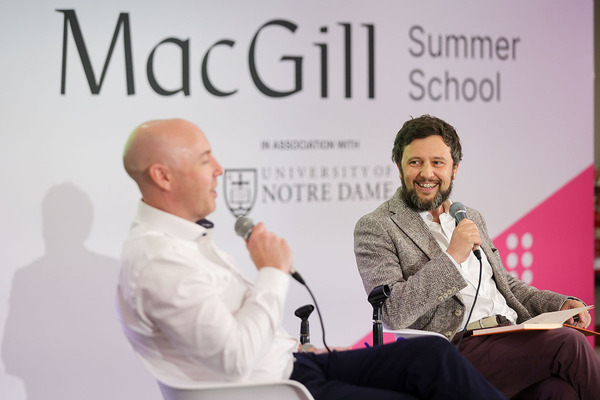
<figcaption>From left, Jon Burrows, leader of the Ulster Unionist Party, speaks with Sam McBride, the Northern Ireland editor for the Belfast Telegraph and Sunday Independent newspapers.</figcaption>
</figure>
<p>A further panel that piqued interest this year was on unionism in 2026, with Belfast journalist Sam McBride and Jon Burrows. Burrows spoke candidly about how, in his view, unionism has been failing to sell itself well to young people, relying on an outdated tone. He took up the role as Ulster Unionist Party (UUP) leader because he views the party as unequivocal in pursuing unionism without sectarianism. He reiterated that in his view “peace is not enough ... we need to make Northern Ireland work.” Burrows was also critical of how reform in the north has often only come in response to crisis, and argued that efficiency at Stormont could be improved. Overall, he felt that for those he represents, day-to-day issues take priority over constitutional change, summing this up as “potholes, not border polls.”</p>
<p>These panels represent just a brief insight into some of the many and varied discussions that took place at this year’s MacGill. What is also particularly heartening to see is an increasingly diverse audience, and higher numbers of young people attending year on year. As a forum to engage with cutting edge debate on current affairs the value of MacGill really cannot be underestimated. Perhaps this sentiment is best encapsulated by Queen’s University Belfast student, and regular attendee, James Tourish who said:</p>
<p style="padding-left: 40px;"><em>Having attended the MacGill Summer School for the last three years as a student, I’ve always found the discussions and panels highly engaging and relevant to my studies as a politics and IR student at Queen’s University Belfast. The Summer School offers the opportunity to listen to those in many different fields, from elected politics to the world of medicine and global health policy. For anyone interested in current affairs, I think it’s a must-attend for anyone making summer plans.</em></p>
<p style="padding-left: 40px;"><em>One of the unique experiences in being an attendee that I’ve found, is the conversations with those also in attendance and even some of the speakers. With so many people from a variety of backgrounds, you can sit down with someone and have a conversation about something, and then 10 minutes later have a chat about something entirely different! The breadth and depth of knowledge is not something replicated in many other places.</em></p>
<p style="padding-left: 40px;"><em>For anyone interested in current affairs or anything policy related, I really could not recommend attending the MacGill Summer School in Glenties enough, which at the very least, will provide you with a chance to experience the beautiful Donegal breeze and chats with the friendliest locals and fellow attendees.</em></p>
<p><strong>Learn more about the MacGill Summer School at <a href="https://www.macgillsummerschool.com/">macgillsummerschool.com</a>.</strong></p>]]>
    </content>
    <link rel="enclosure" type="image/jpeg" href="https://irishstudies.nd.edu/assets/674293/macgill_26_0066.jpg" title="Panel at MacGill Summer School 2026, associated with Notre Dame. Speaker at podium, four panelists, and large audience."/>
    <author>
      <name>Keough-Naughton Institute</name>
    </author>
  </entry>
  <entry>
    <id>tag:irishstudies.nd.edu,2005:News/182973</id>
    <published>2026-07-15T09:25:00-04:00</published>
    <updated>2026-07-15T09:26:46-04:00</updated>
    <link rel="alternate" type="text/html" href="https://irishstudies.nd.edu/news/student-blog-korea-lesson-for-ireland/"/>
    <title>Student Blog: What comes after foreign direct investment? Korea’s lesson for Ireland</title>
    <summary type="text">
      <![CDATA[Faiza Filali, a summer intern with ARINS (Analysing and Researching Ireland North and South), observes, “Korea and Ireland set out from almost the same place: colonised, partitioned, poor, emptied by emigration. On Korean Constitution Day, it’s worth asking why one country owns its prosperity and the other mostly rents it.”]]>
    </summary>
    <content type="html">
      <![CDATA[<p><em>Faiza Filali graduated from the University of Notre Dame in May with a bachelor’s degree in political science and government. This summer, through <a href="https://dublin.nd.edu/programs/irish-internship-program/">Notre Dame Dublin’s Irish Internship Program</a>, she is working with ARINS (Analysing and Researching Ireland North and South), a joint project of the Keough-Naughton Institute for Irish Studies in Notre Dame’s Keough School of Global Affairs and the Royal Irish Academy.</em></p>
<p><em>She wrote this opinion piece for an Irish audience with the observation, “</em><em>Korea and Ireland set out from almost the same place: colonised, partitioned, poor, emptied by emigration. On Korean Constitution Day, it’s worth asking why one country owns its prosperity and the other mostly rents it.”</em></p>
<hr>
<figure class="image image-right"><img src="https://irishstudies.nd.edu/assets/666177/arins_faiza_filali_3x2.jpg" alt="Young woman with dark hair, a light blue shirt, and red lipstick smiles broadly by a brick building with a blue plaque." width="600" height="400">
<figcaption>Faiza Filali stands outside O’Connell House, home of Notre Dame Dublin. The flag of the Republic of Korea’s embassy can be seen in the distance over her shoulder.</figcaption>
</figure>
<p>Every 17 July, Korea celebrates a holiday that most Koreans now spend at work. Jeheonjeol, Constitution Day, marks the morning in 1948 when a country that had spent 35 years as a Japanese colony and was weeks away from being cut in half sat down and wrote itself a constitution. It was a national holiday for 60 years. Then, in 2008, when the five-day week came in, the government quietly removed the day from the calendar of paid holidays. Though it has recently returned, some Koreans still clock in to the office regardless. There is something distinctly Korean about a country so busy building itself that it stopped taking the day off it had set aside to celebrate its own founding.</p>
<p>I lived in Seoul for a year, and what stayed with me wasn’t the place’s speed, though that can’t be denied. The Han River cuts through Seoul much as the Liffey runs through Dublin, although on a vastly different scale. Walk along the Han on a summer evening, past the cyclists and the convenience-store soju and the apartment towers stacked up the far bank, and you’re looking at a river that lent its name to the most dramatic economic story of the last century. In 1960, income per head in Korea was less than 100 euros a year, lower than that of most of sub-Saharan Africa. Today it’s north of 30,000.</p>
<p>You feel that memory in the people, not just in the figures. The grandmothers selling vegetables near Gyeongbokgung were children during the Korean War, when Seoul changed hands four times, and much of it was reduced to rubble. Their grandchildren now queue for flat whites in Seongsu, a district of old shoe factories now turned into cafés and flagship stores, similar to the transformation of Dublin’s Dockyards. Two generations, from real hunger to one of the richest cities on earth. Koreans carry that arc consciously, and it shows up in the films, the politics, the pride, and the anxiety alike. A society that remembers being poor behaves differently from one that has only ever known comfort, and a good deal of what reads as relentlessness from the outside is really that memory still doing its work.</p>
<p>Why bring this to an Irish reader? Because Korea’s starting line looked very much like Ireland’s. Both countries were colonised by a powerful neighbor next door and spent a long time being told they were too backward to run their own affairs. Both were partitioned within a few years of independence, and both still live with the border that resulted from it. Both were agricultural, both were poor, and both shipped their own people abroad by the boatload because there was nothing for them at home. In the 1950s, Ireland was losing more than 45,000 emigrants a year, even as its population was falling. We tend to think of Korea as impossibly far away, culturally and geographically. But the two states only recognised each other in 1983, and Ireland didn’t open an embassy in Seoul until 1989, which is almost funny given how much the two had been through in parallel.</p>
<p>Then Korea did the thing that Ireland is, in a sense, still trying to finish. Over roughly three decades, the economy grew at an average of nearly 10 percent per year. By the mid-1990s, real output was about 25 times what it had been in 1960. A country that exported wigs and plywood in the 1960s now exports memory chips, ships, cars, and pop music, and the firms that make them are names you know: Samsung, Hyundai, POSCO, LG. That is the miracle on the Han, and it is a rare case where the word “miracle” is doing honest work. Imagine if CRH, Ryanair, Kerry Group, and Kingspan together accounted for a substantial share of Ireland's economy. That begins to illustrate the scale of Korea's largest industrial groups.</p>
<figure class="image image-default"><img src="https://irishstudies.nd.edu/assets/666315/fullsize/faiza_filali_korea_photos.jpg" alt="Smiling woman explores Korean landmarks, a river, and cityscapes, wearing traditional hanbok in one photo." width="1200" height="800">
<figcaption>
<div>
<div dir="auto">Faiza Filali in South Korea, clockwise from top left: Namsan, Seoul; Gwangju Uprising Memorial; Suwon Hwaseong Fortress; Gwanghwamun Palace; Specialty Guinness Bar, Yeonnam-dong; and Pyeongchang, Gangwon-do.</div>
</div>
</figcaption>
</figure>
<p>How Korea did it matters more than the fact that they did. And this is the part that gets flattened when the story reaches Dublin, usually into a vague moral about hard work and good schools. Korea’s growth was built by the state, deliberately and often brutally. Park Chung-hee, the general who seized power in 1961, ran the economy through five-year plans and export targets. The government picked industries it wanted, then bankrolled them with cheap credit. The economist Alice Amsden called the underlying bargain reciprocity: the subsidies came with conditions attached, and a firm that missed its export numbers could lose the support that kept it alive. Korea, in Amsden’s phrase, deliberately got relative prices “wrong” to force the pace of industrialization and disciplined the companies it favored rather than simply handing them money.</p>
<p>And here is the detail Ireland should pay closest attention to. Korea built its own companies. It borrowed heavily from abroad, took in foreign technology, sent its engineers to be trained in American and Japanese plants, but it kept foreign ownership of its industry on a very short leash. The chaebol, for all their faults, are Korean. The profits, the patents, and the head offices stayed in the country. When Samsung climbed from making cheap televisions to leading the world in memory chips, that climb belonged to Korea.</p>
<p>Ireland turned outward at almost exactly the same moment, and this is the parallel that ought to make us sit up.</p>
<p>In 1958, a senior civil servant named T.K. Whitaker published a report, <em>Economic Development</em>, that argued the country could not keep hiding behind tariffs while its people emigrated. Seán Lemass, who had spent the 1930s building those very tariffs, took the argument on board as Taoiseach and dismantled much of the protection he had created. Ireland threw open the doors.</p>
<p>But the engine it chose was the mirror image of Korea’s. Rather than build national champions, Ireland invited the world’s champions to come and set up here, with grants, a famously low corporate tax rate that settled at 12.5 percent, an English speaking workforce, and, after 1973, a seat in the European market. And it worked, spectacularly. The multinationals came, the jobs came, and by the late 1990s, the Celtic Tiger was the envy of Europe.</p>
<p>This is where the two stories quietly split, and why Constitution Day deserves attention in Ireland. Korea owns its prosperity. Ireland, to a degree, reluctantly said out loud, hosts someone else’s.</p>
<p>The distortion is now so large that the Central Statistics Office had to invent a separate measure, modified gross national income (GNI*), just to see the real Irish economy underneath the multinational accounting. In 2024, the real economy was about 57 percent of headline GDP. The other 43 percent is, in effect, a statistical shadow cast by companies that are booking global activity through Dublin. In the same year, firms based in Ireland paid out roughly 169 billion euros in royalties and license fees to parent companies abroad. Though the jobs remain here, much of the intellectual property, as it seems, does not.</p>
<p>The jobs are real, and the tax receipts are real. But a great deal of the wealth is passing through rather than staying.</p>
<p>The clearest tell is research, because research is what lets a country keep moving up the ladder once the easy gains are gone. For every 100 euros produced by the Korean economy, roughly 5 euros is reinvested in research and development. The striking thing is that most of it is Korean firms spending Korean money on Korean problems. Ireland invests closer to 1 euro. Worse, of the business research that does happen on Irish soil, foreign-owned companies account for roughly 84 percent, and Irish-owned companies just 16 percent. Ireland seems to have become very good at hosting other people’s laboratories and much slower at building its own.</p>
<figure class="image image-default"><img src="https://irishstudies.nd.edu/assets/666334/fullsize/faiza_filali_ireland_photos.jpg" alt="Smiling woman: Cliffs of Moher in hood; Notre Dame Alumni hat on bus; black jacket by stone archway and city sign." width="1200" height="800">
<figcaption>
<div dir="auto">Faiza Filali in Ireland, clockwise from left: Galway City, Cliffs of Moher, and riding the DART in Bray, south of Dublin.</div>
</figcaption>
</figure>
<p>So what is the lesson, and, just as importantly, what is not? I am not going to pretend Ireland should reach for Park Chung-hee’s playbook. His Korea was a dictatorship that jailed its opponents, and the chaebol model carries real costs that Koreans themselves now argue about constantly: dangerous concentration, families controlling vast empires, an economy so dependent on a handful of firms that Samsung Electronics alone accounts for around a fifth of national research spending. A country that leans so heavily on so few companies is exposed, as Korea found out during the 1997 financial crisis. The transferable lesson is narrower and more useful than “be more like Korea.”</p>
<p>It is this. Treat foreign investment as a foundation, not as the finished building. Korea used foreign capital and technology as a means to an end: a domestic industry that could eventually stand on its own and overtake its teachers. Ireland has spent 60 years laying an extraordinary foundation: the deepest cluster of pharmaceutical and technology multinationals in Europe, supported by a workforce trained within those firms.</p>
<p>What it has been slow to do is the second move: convert that foundation into Irish-owned companies, Irish-owned patents, and Irish research that the next downturn cannot simply relocate. The corporate-tax windfall of recent years, including the 13 billion euros from the Apple ruling, is precisely the kind of money Korea would have poured into building national capacity. It could fund a serious indigenous research base, back Irish firms with the ambition to scale globally, and strengthen the universities that any homegrown industry has to draw on. Korea’s real advantage was never cheap labor or Confucian work ethic. It was a state willing to choose, invest patiently, and ask for results in return.</p>
<p>Bring it back to the constitution. A constitution is what a country’s written down about what it intends to become, usually before it has the means to get there. Korea wrote one in 1948 with a war on the horizon and 80 dollars a head to its name, and then spent half a century making the document true, on its own terms and with its own companies.</p>
<p>Ireland made its own outward turn in 1958 and grew rich on a clever, generous bet that the rest of the world would build its industries here. The bet paid off. The question Constitution Day poses, read from Dublin rather than Seoul, is what the next 50 years are for: owning the prosperity it has built, or continuing to rent it.</p>
<p>Korea settled that question a long time ago. Perhaps it is time Ireland did too.</p>]]>
    </content>
    <link rel="enclosure" type="image/jpeg" href="https://irishstudies.nd.edu/assets/666177/arins_faiza_filali_3x2.jpg" title="Young woman with dark hair, a light blue shirt, and red lipstick smiles broadly by a brick building with a blue plaque."/>
    <author>
      <name>Faiza Filali</name>
    </author>
  </entry>
  <entry>
    <id>tag:irishstudies.nd.edu,2005:News/182860</id>
    <published>2026-07-06T10:35:00-04:00</published>
    <updated>2026-07-20T08:38:21-04:00</updated>
    <link rel="alternate" type="text/html" href="https://irishstudies.nd.edu/news/in-memoriam-martin-naughton/"/>
    <title>In Memoriam: Martin Naughton</title>
    <summary type="text">
      <![CDATA[Martin Naughton — an Irish businessman, philanthropist, and one of the benefactors for whom the Keough-Naughton Institute for Irish Studies is named — passed away on July 3, 2026. He was 87.]]>
    </summary>
    <content type="html">
      <![CDATA[<p class="lede">Martin Naughton — an Irish businessman, philanthropist, and one of the benefactors for whom the Keough-Naughton Institute for Irish Studies is named — passed away on July 3, 2026. He was 87.</p>
<figure class="image image-right"><img src="https://irishstudies.nd.edu/assets/665273/9112_naughtons_nd_vs_navy.jpg" alt="Enda Kenny, Fr. Jenkins in clerical attire, and two smiling adults in green Notre Dame fleeces." width="600" height="400">
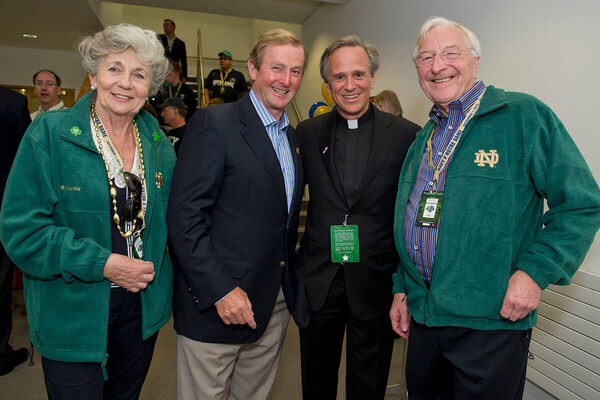
<figcaption>From left, Carmel Naughton, then-Taoiseach Enda Kenny, then-University President Rev. John Jenkins, C.S.C., and Martin Naughton pose for a photo on Sept. 1, 2012, before the Notre Dame-Navy football game in Dublin.</figcaption>
</figure>
<p>Through his business acumen and generosity, Naughton contributed to the making of Ireland as it is today: a place that is remarkably more prosperous, more connected, and more peaceful than it was a half-century ago.</p>
<p>An engineer by training, Naughton founded an electrical appliance company in 1973 with 10 employees at a small factory in Newry, a town in Northern Ireland near the border with the Republic of Ireland and his home county, Louth. Through innovation and insightful acquisitions, Naughton grew the company into what is now the Glen Dimplex Group — a global company with plants in 20 countries and more than 8,000 employees who make low-carbon heating and ventilation solutions.</p>
<p>On this side of the Atlantic, Naughton helped bring Notre Dame to Ireland and Ireland to Notre Dame. He and the late <a href="https://news.nd.edu/news/in-memoriam-donald-r-keough-chair-emeritus-of-the-notre-dame-board-of-trustees/">Donald Keough</a>, a former Coca-Cola executive and chair of the University’s Board of Trustees, were the keys to deepening Notre Dame’s connections with Ireland over the past 30 years. The two friends supported numerous academic initiatives and programs that linked Notre Dame with Ireland as well as marquee events like the Fighting Irish football games in Dublin.</p>
<p>The Keough Institute for Irish Studies was founded in 1992. Keough, whose gift to the University established the institute, proposed in 2006 that it be renamed the Keough-Naughton Institute to acknowledge the profound interest both men shared in Ireland and Notre Dame’s commitments on the island.</p>
<p>The Keough-Naughton Institute, which is now part of Notre Dame’s <a href="http://keough.nd.edu">Keough School of Global Affairs</a>, has become a world leader in the multidisciplinary field of Irish studies. The institute focuses on teaching and research in both the humanities and public policy — two strands of activity that are mutually reinforcing and a reflection of the founders’ passion for history, literature, language, art and the future of Ireland.</p>
<p>“Martin’s generosity and commitment to education have left an enduring legacy at the Keough School,” said <a href="https://keough.nd.edu/about/faculty-staff-directory/mary-gallagher/">Mary Gallagher</a>, the Marilyn Keough Dean of the Keough School of Global Affairs. “Through the Keough-Naughton Institute, he helped create a place where students and scholars deepen their understanding of Ireland, build lasting relationships and strengthen the ties between Ireland and Notre Dame. His legacy will continue to be felt in the lives of those who learn, teach and collaborate through the institute for generations to come. We are deeply grateful for all that he and Carmel have meant to our community, and we continue to hold their family in our prayers.”</p>
<p>In addition to the institute, Naughton helped make it possible for the University to establish <a href="https://dublin.nd.edu/">Notre Dame Dublin</a>, located in the historic O’Connell House on Merrion Square, as well as <a href="https://kylemore.nd.edu/">Notre Dame Kylemore</a>, located at Kylemore Abbey in Connemara. The <a href="https://naughton.nd.edu/">Naughton Fellowships</a> provide students in STEM fields with international research and learning opportunities through a funded exchange program between Notre Dame and Ireland’s leading research universities. He was a member of the University’s Board of Trustees since 1999.</p>
<p>“It’s hard to overstate Martin Naughton’s impact on the University of Notre Dame. He strengthened ties between Ireland and the United States, connected Notre Dame with Ireland in new and meaningful ways, and helped Notre Dame become a more global university,” said <a href="https://irishstudies.nd.edu/core-identity/director-and-staff/prof-colin-barr/">Colin Barr</a>, the Thomas Moore and Judy Livingston Director of the Keough-Naughton Institute and professor of modern Irish history in the Keough School of Global Affairs. “His legacy will live on across the island of Ireland as well as in the relationships he built with Notre Dame and other partners around the world.”</p>
<p>Naughton believed strongly in the power of education to transform people’s lives. He made large gifts to several universities on the island of Ireland as well as to Notre Dame.</p>
<p>He and his family have also been enthusiastic about the arts in Ireland, with support for the National Gallery of Ireland in Dublin, the Naughton Gallery at Queen’s University Belfast, the Royal Irish Academy, and the Lyric Theatre Belfast, among other organizations. In 1992, the couple bought and restored Stackallan House, an 18th century estate in County Meath.</p>
<p>“You put money into what rings your bell,” Naughton told the Financial Times in a 2018 profile.</p>
<p>He and his wife, Carmel, received several honors for their philanthropy and service. He was appointed a Knight of the British Empire and an Officier de la Legion d’Honneur of France.</p>
<p>In 2025, in one of his last acts, Pope Francis conferred the honor of the <a href="https://irishstudies.nd.edu/news/vatican-honors-martin-and-carmel-naughton-with-papal-award/">Order of Saint Gregory the Great</a> upon the couple in recognition of their outstanding philanthropy in the areas of education and the arts, particularly for their support of Catholic education.</p>
<p>The Naughtons also played a part in the Northern Ireland peace process that brought an end to the Troubles. The couple hosted dinners at their home where they invited people from different parts of Ireland, the north and the south, for conversation.</p>
<p>“The peace process is like crossing a river,” Naughton said in 2018 while being honored by the Business for Peace Foundation. “You use stepping stones — big stepping stones, small stepping stones, but a lot of people contribute. ... When you cross the river by the stepping stones, then you can build a bridge, then you can build two bridges, and you start getting things going.”</p>
<p>Naughton is survived by Carmel; their children, Neil, Fergal, and Fiona, co-chair of the Keough-Naughton Institute Advisory Board; and their extended family.</p>
<p><strong>Read the University of Notre Dame’s in memoriam for Martin Naughton at <a href="https://news.nd.edu/news/in-memoriam-emeritus-trustee-martin-naughton/">news.nd.edu</a>.</strong></p>]]>
    </content>
    <link rel="enclosure" type="image/jpeg" href="https://irishstudies.nd.edu/assets/665274/101713_ireland_internship_reception_martin_naughton_1288.jpg" title="A white-haired man with glasses smiles broadly, showing teeth. He wears a dark suit and light blue dress shirt."/>
    <author>
      <name>Kevin Allen</name>
    </author>
  </entry>
  <entry>
    <id>tag:irishstudies.nd.edu,2005:News/182887</id>
    <published>2026-07-03T12:58:00-04:00</published>
    <updated>2026-07-15T09:23:43-04:00</updated>
    <link rel="alternate" type="text/html" href="https://irishstudies.nd.edu/news/global-reach-of-the-irish-working-class-is-explored-at-conference-in-galway/"/>
    <title>Global reach of the Irish working class explored at symposium in Galway</title>
    <summary type="text">
      <![CDATA[A group of 30 scholars, writers, and cultural practitioners convened June 11–12 at the Druid’s Mick Lally Theatre in Galway to discuss Irish working class histories, representations, and creative lives.]]>
    </summary>
    <content type="html">
      <![CDATA[<figure class="image image-default"><img src="https://irishstudies.nd.edu/assets/665365/fullsize/group_photo.jpg" alt="A smiling group of diverse adults stands in a narrow alley. A woman wears a yellow coat. A red 'Druid' sign and green train are visible." width="1800" height="1200">
<figcaption>Symposium participants in front of the Druid Theatre.</figcaption>
</figure>
<p>A group of 30 scholars, writers, and cultural practitioners convened on June 11–12 at the Druid’s Mick Lally Theatre to discuss Irish working class histories, representations, and creative lives as part of the symposium, “Representing the Global Irish Working Class: National and International Contexts and Dialogues.”</p>
<p>The symposium was organized by the Keough-Naughton Institute for Irish Studies in the University of Notre Dame’s Keough School of Global Affairs and the University of Galway, with organizational leadership from Dr. Ciara McAllister, postdoctoral research fellow at the University of Galway, and Ariel Clark-Semyck, assistant director for research programs at the Keough-Naughton Institute.</p>
<p>In keeping with the symposium’s title, presentations explored how the lived realities as well as artistic and media portrayals of the Irish working class have shaped and been shaped by the socioeconomic and cultural dimensions of globalization. Due consideration was also paid to the formation and navigation of class within Ireland and local contexts. Throughout the two days, conversations centered on the movements of working-class writers, artists, and activists who have dedicated themselves to self-representation through creative expression and community organizing.</p>
<h2>Irish working-class histories and activism</h2>
<p>Several participants focused their talks on working-class histories in Ireland, tracing workers’ patterns of resistance to social and economic oppression. Constantin Torve (Queen’s University Belfast) examined class structure in 19th century rural Ireland and the secret labor societies that mobilized in response to poor wages and land evictions. Olivier Coquelin (University of Caen Normandy) discussed the rise of the Irish soviets, localized labor activism, and media coverage during the revolutionary period. Susannah Deedigan (Queen’s University Belfast, Keough-Naughton Institute) considered the letters of appeal written by wives, family members, and advocates of male political prisoners in the 1940s, documenting rhetorical strategies that argued for the internee’s release based on his role as a family breadwinner and “good worker” for Ireland. Emma Penney (Atlantic Technological University) delineated connections between the welfare rights movement led by Black working-class women in the U.S. in the 1960s, which inspired Irish working-class women’s welfare rights advocacy in the 1980s. As Penney highlighted, the activism took shape through political protest as well as through self-narration and collective storytelling: a “transperipheral” articulation of working-class feminism.</p>
<figure class="image image-right"><img src="https://irishstudies.nd.edu/assets/665523/2026_thursday_notredame_lowres_61.jpeg" alt="Three panelists sit in red chairs on a stage with microphones and flowers for a panel discussion." width="600" height="400">
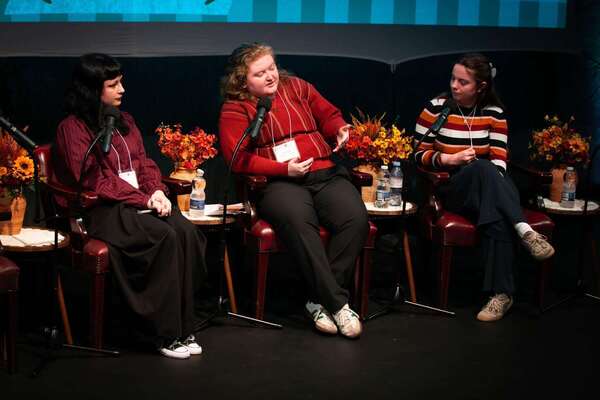
<figcaption>Oana Spătăriuc, Zara Meadows, and Claire Creedon answer audience questions after their panel.</figcaption>
</figure>
<h2>Working-class representation in literature, theatre, and the arts</h2>
<p>Other papers explored a variety of works that portray working-class life in Ireland and follow the Irish emigrant worker abroad. Claire Creedon (Queen’s University Belfast), Andrew Mullan (Queen’s University Belfast), Brian Kelly (King’s College London), and Zara Meadows (Queen’s University Belfast) presented on contemporary Irish writers such as Anna Burns, Michael Magee, Lisa McInerney, and Matthew Rice, illuminating how their works break new ground in form, focus, and voice to communicate working-class perspectives. At the heart of these analyses was the spotlighting of experimentation and innovation in working-class writing as well as critical insight into the power dynamics and artistic implications of observation. A version of a flâneur that is far from idle — as Meadows conceptualized in their presentation on Rice’s poetry collection <em>Plastic</em> — emerges as a narrativizing figure across these texts. Each presentation demonstrated how the surveilling eyes of state force, unfriendly onlooker, or the workplace punchclock are met with the working-class flâneur’s own gaze that chronicles, challenges, and makes incisive art of it all.</p>
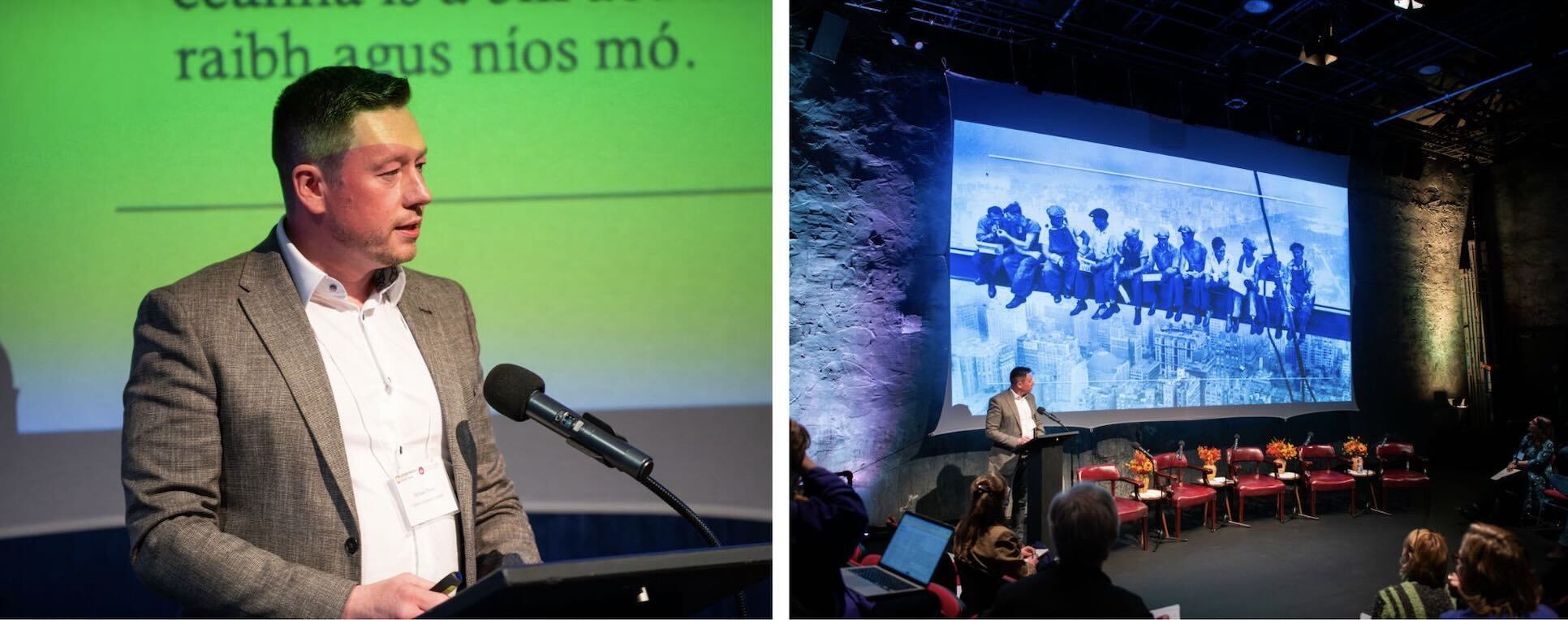
<p>Keynote speaker Michael Pierse (Queen’s University Belfast) delivered a comprehensive survey of writing on the Irish emigrant worker. Focusing on early 20th century authors including Patrick MacGill, James Hanley, Robert Tressell, and Sean O’Casey, Pierse underscored a condition that haunts their narratives of the Irish diaspora: an estrangement from place of origin and destination. Pierse’s reading of these texts emphasized how the working class contended with adversity wrought from colonial oppression and restrictive social norms in Ireland. Upon emigrating, however, Irish workers went on to encounter alienation and industry exploitation in their adopted homes. Despite the grim circumstances of the Irish emigrant worker as depicted in these narratives, the literary representation was revolutionary. Pierse highlighted how these writers, from working-class backgrounds themselves, drew from personal experience to tell the stories of those living and laboring on the margins.</p>
<figure class="image image-default"><img src="https://irishstudies.nd.edu/assets/665522/fullsize/michael_pierse.jpg" alt="A man in a grey suit speaks at a podium. Behind him, a large screen displays workers on a skyscraper beam, alongside a green panel." width="1932" height="764">
<figcaption>Michael Pierse delivers his keynote, "Out of Kilter: Radical Perspectives in Irish Emigrant and Diaspora Working-Class Writing, from Robert Tressell to Lee Dunne."</figcaption>
</figure>
<p>Keith Hennessy (University of Liverpool), Oana Spătăriuc (Babeș-Bolyai University), Teresa Dunne (University of Galway), and Niamh MacGloin (University of York) also presented on literature of the Irish working-class diaspora, discussing authors Pádraic Ó Conaire, Dónall Mac Amhlaigh, Robert Tressell, and James Hanley among others. Central themes gleaned from these textual analyses were the Irish emigrant figure’s constant renegotiation of identity, culture, and language amidst pressure to assimilate, as well as compounding experiences of discrimination based on class, ethnicity, and disability.</p>
<p>Moving beyond the page, other participants discussed working-class representation as shown on stage, screen, or house siding. Paul Murphy (Queen’s University Belfast) traced traditions of political dissent in Irish diasporic theatre. Maria McGarrity (Long Island University) presented on Brian Campbell’s <em>Voyage of No Return</em>, a play that situates contemporary racism alongside the history of the 1768 St. Patrick’s Day Rebellion in Montserrat led by enslaved Africans against their Irish enslavers. John Hill (Royal Holloway London) provided an extensive media history of television dramas that portray Northern Ireland’s working class across eras. Rebecca Steinberger (Misericordia University) and Ana-Maria Someşan (Babeș-Bolyai University) each reflected on Kneecap’s global popularity, and how Belfast working-class identity, Gaeilge revival, and transnational anti-colonialism are at the forefront of their music. Struan Kennedy (Peace &amp; Justice Scotland) discussed loyalist, working-class murals and the possibilities that symbols hold for mis/representation, fostering solidarity, or deepening division.</p>
<figure class="image image-left"><img src="https://irishstudies.nd.edu/assets/665516/derry_after_derry_girls_panel_ciara_mcallister_gary_crossan_and_rachel_harley.jpeg" alt="Three smiling panelists, two women and a man, on stage with microphones. Background shows University of Galway and Keough-Naughton Institute logos." width="600" height="400">
<figcaption>Ciara McAllister, Rachel Harley, and Gary Crossan discuss Derry after <em>Derry Girls</em>.</figcaption>
</figure>
<h2>Working-class leadership in the arts</h2>
<p>The symposium also foregrounded conversation about working-class leadership in cultural arts organizations and the importance of making identity-affirming creative spaces and career pathways available to all artists. Holly Foskett (founder, <a href="https://www.instagram.com/_weareclass_/">We Are Class</a>) presented her research into socioeconomic and structural barriers that hinder participation in the arts, as well as organizations in Belfast, such as <a href="https://www.eastsidearts.net/">EastSide Arts</a>, that offer professional development programs and community-based projects for working-class artists. Ciara McAllister joined Gary Crossan, producer for <a href="https://www.derryplayhouse.co.uk/">The Playhouse Derry</a>, and actress Rachel Harley for a conversation on The Playhouse’s mission to peacebuild and offer accessible career training for local performers. The panel also discussed the impact <em>Derry Girls</em> has had on Derry and its creative industries. While <em>Derry Girls</em> served as a gateway for global audiences to see and get to know the city, discussants agreed that the TV show should serve as a starting point for people to further research and understand Derry’s history. Crossan and Harley also shared the positive industry effects that <em>Derry Girls</em>, and other TV and film productions set in the North, have had, such as the development and regular hire of highly trained local crews and creative professionals on these sets. They also emphasized that more cross-border arts funding and organizational collaboration could build a more supportive network for early-career practitioners.</p>
<h2>The Writers’ Roundtable</h2>
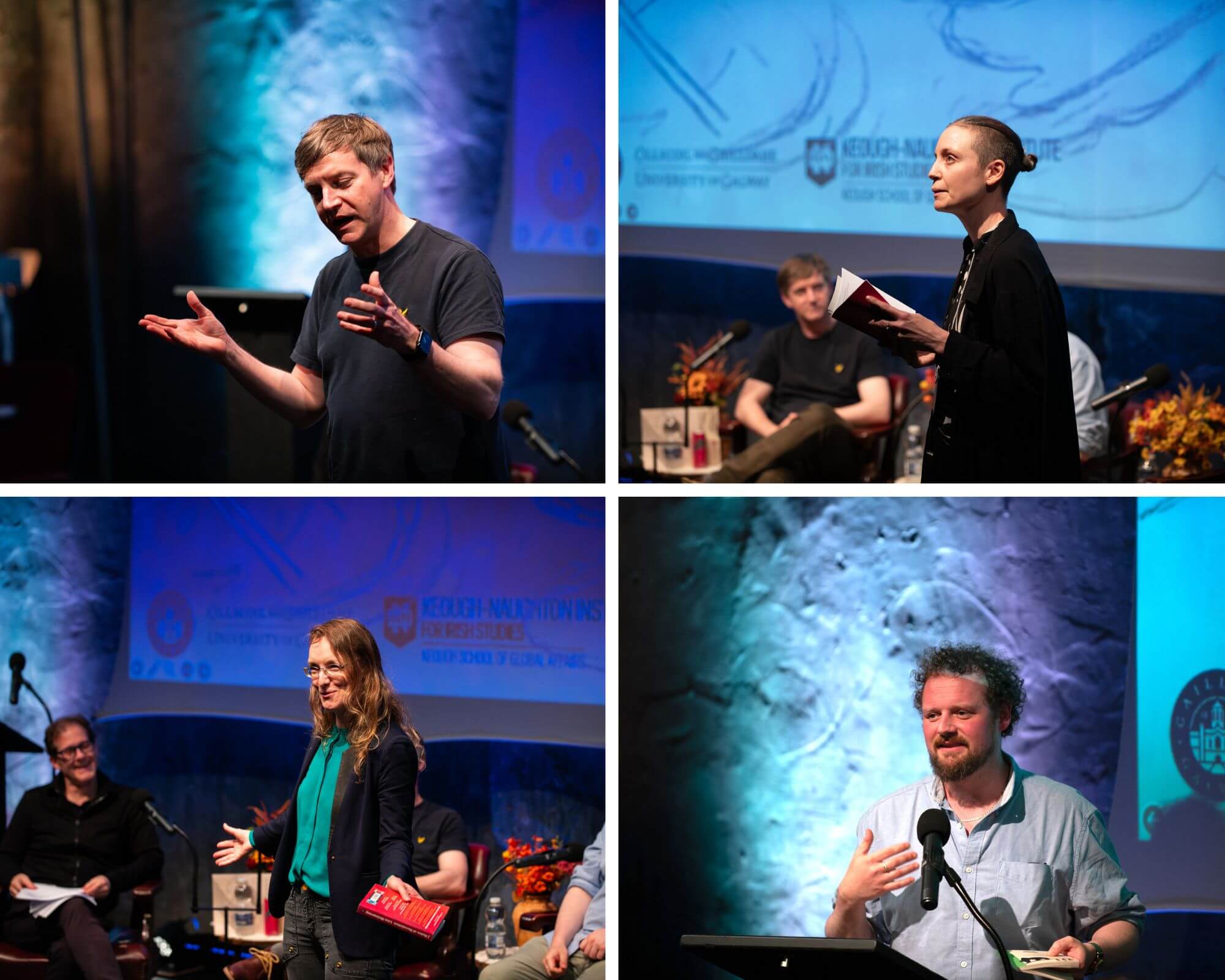
<p>The symposium came to an exhilarating close on the second day with a set of readings by Emmet Kirwan (<em><a href="https://www.bloomsbury.com/us/dublin-oldschool-9781474290739/">Dublin Oldschool</a>, Accents</em>), Fran Lock (<em><a href="https://www.pamenarpress.com/product-page/hyena-jackal-dog">Hyena!</a>, <a href="https://www.outspokenldn.com/shop/vulgar">Vulgar Errors/ Feral Subjects</a></em>), Lisa McInerney (<a href="https://www.penguinrandomhouse.com/books/536428/the-glorious-heresies-by-lisa-mcinerney/"><em>The Glorious Heresies</em></a> trilogy), and Scott McKendry (<a href="https://www.hachette.co.uk/titles/scott-mckendry/gub/9781472158079/"><em>Gub</em></a>). Readings spanned a vast terrain in terms of subject, style, and genre. Kirwan performed two spoken-word pieces from his plays: one weaving through the thrumming milieu of Dublin nightlife, and the other a dynamic contemplation of fatherhood. Lock delivered a sonic-bloom of polyvalent poetics on the entanglements of class and gender performance. McInerney read an excerpt of zinging dialogue from her novel, <em>Rules of Revelation</em>, that reflects on the persisting trauma of the Magdalene Laundries. McKendry shared poems from <em>Gub</em>, a collection that depicts family and community life, the imprint of the Troubles, and no shortage of geese within working-class Belfast in vivid specificity — and with sharp wit, compassion, and a delight in all that language can do. A roundtable moderated by Dan Carey (University of Galway) followed the authors’ readings, and the group discussed how working-class consciousness shapes writing practice as well as artistic decisions in subject, language, and form. Discussants also commented on the ways that class is still glossed over — purposefully and unconsciously — in arenas of literary culture and critique, and that working-class writers often face pressure to mask aspects of their identity.</p>
<figure class="image image-default"><img src="https://irishstudies.nd.edu/assets/665519/fullsize/writers.jpg" alt="Four individuals speaking at a Keough-Naughton Institute for Irish Studies event. They are gesturing, holding books, and lit by blue light." width="2000" height="1600">
<figcaption>Emmet Kirwan, Fran Lock, Lisa McInerney, and Scott McKendry deliver readings.</figcaption>
</figure>
<h2>Participant reflections</h2>
<p>After the symposium concluded, organizer Ciara McAllister and other participants offered the following reflections on the gathering:</p>
<p style="padding-left: 40px;">“On behalf of myself and the Department of Drama and Theatre Studies at the University of Galway, I want to thank Colin Barr, Ariel Clark-Semyck and the Keough Naughton Institute for being such enthusiastic partners on this symposium and thank all of the participants and audience members who gave up their time to enrich the event. Our aim with this symposium was to bring together scholars working on class across the globe to share their insights and experiences from their own national contexts. We were delighted to welcome speakers from universities in Ireland, Britain, France, Romania, and the United States, working across a variety of disciplines to form new partnerships and begin new conversations on where Irish studies and working-class studies can meet. After a truly inspiring and invigorating two days of discussion, it is clear that understanding shared commonalities across borders, amplifying marginalised voices, and celebrating different forms of culture can only strengthen our discipline. I look forward to seeing the inevitable impact that these conversations will have on research and scholarship moving forward.” – Ciara McAllister</p>
<p style="padding-left: 40px;">“The Representing the Global Irish Working Class Symposium proved to be a highly enjoyable and intellectually stimulating event. Bringing together scholars and cultural practitioners of different generations from across Ireland, Britain, continental Europe and the USA, the event successfully broadened the scope of discussion of the Irish working class and helped to raise awareness of the importance of this for Irish studies, and Irish Cultural Studies in particular. The event was notable for the supportive and convivial way in which debate was conducted and I’m sure that we all left both intellectually recharged and ready to carry on more work in the same vein.” – John Hill</p>
<p style="padding-left: 40px;">“The Representing the Global Irish Working Class Symposium brought together a phenomenal group of researchers at the Druid Theatre. The papers were wide ranging and provocative; they showcased engaging intersections between academic research and the lived experience of both panelists and community members. A sure sign of an excellent conference, conversations continued well into the after-hours as innovative ideas were discussed, and new projects were forged. Thanks to the organizers for setting up the conference and establishing an atmosphere of scholarly good cheer that made these connections possible.” – Maria McGarrity</p>
<p style="padding-left: 40px;">“This conference was a resounding success. Ciara and Ariel must be praised highly as attentive and embedded hosts. The venue, the food and the general atmosphere were exemplary. This was the most useful and encouraging conference within the field of Irish Studies that I've been at. Everyone mingled and chatted — sometimes shop, sometimes getting-to-know-you — and debates were conducted with professionalism, grace and even joviality. Genuine friendships were formed. Contributors and attendees were diverse in background and interest, and each paper was rich, enthused and full of novel lines of thought. We’d fresh insights on Irish pop culture, a critical thesis on ekphrasis and factory work, a quantitative take on class nuance in nineteenth-century Ireland, and more. Throughout, discourse remained genuinely pluralistic and democratic. All sorts of connections were made. It was, from my perspective at any rate, a landmark in our understanding of what the words 'class' and 'Ireland' mean. It was class.” — Scott McKendry</p>
<p style="padding-left: 40px;">“An outstanding, landmark Irish studies gathering, ‘Representing the Global Irish Working Class: National and International Contexts and Dialogues’ ranged from evocative readings and performances to cutting-edge new research on class and culture in the Irish world. This conference, so ably organised by the University of Galway’s Dr Ciara McAllister and Notre Dame’s Ariel Clark-Semyck, brought a gathering of specialists and creatives together in a well-curated series of panels that will no doubt lead to further academic collaborations in this growing field. The programme rightly contended that ‘globalisation has not only transformed Irish culture and society, it has redefined what it means to belong to the Irish working class’, and this reality was explored repeatedly through compelling papers that emphasised the rich, exceptionally complicated and global experience of Irish working-class life. A dynamic mix of undergraduate, doctoral, early-career and experienced academic perspectives, along with practitioner and artist voices, made for a fascinating and representative dialogue. Papers covered everything from the historical formation of class in Ireland, to class and disability studies, to factory ekphrasis, to the representation of migrant labour and identity, working-class masculinities, TV dramas of the northern conflict, transperipheral feminisms, and the modern performance of class conflict by Kneecap and the post-crash Irish novel. The author readings were particularly evocative — you couldn’t hear a pin drop for some, you couldn’t stop laughing with others. It was also nice (and very appropriate) that this conference was free and open to the public. It made for a more accessible, relaxed vibe that shone through, for example, in sessions where the audience took over the Q&amp;A. I can’t thank or praise our organisers enough; it has been a long time coming, but it feels like the study of class and culture in Ireland is now on a solid footing with a range of emerging scholars carrying it forward with brio and ground-breaking, insightful research.” – Michael Pierse</p>
<p style="padding-left: 40px;">“Representing the Global Irish Working Class was an amazing experience that has transcended the two-day event at Mick Lally Theatre in Galway. From the first panel to our final dinner together, the community of scholars from diverse and interdisciplinary backgrounds forged new pathways into this important area of study. Because this was a safe space, academics, art practitioners, and students of Irish studies freely discussed and debated over two days in this theatre with a storied past.” – Rebecca Steinberger</p>
<p style="padding-left: 40px;">“The symposium was an outstanding opportunity to discuss issues of class in Ireland that could not have come at a more pressing time, with the riots in Belfast immediately preceding it. The interdisciplinary strength of the panels, ranging from historical aspects to contemporary popular culture and featuring academics as well as cultural practitioners, reflected a growing interest in matters of class as both an analytical lens and a present-day social factor. In a context where this dimension has all too often been neglected in favour of sectarian or national narratives, a reckoning with the stark class divide underpinning Irish society past and present is overdue, and this symposium has laid a strong foundation for it.” – Constantin Torve</p>]]>
    </content>
    <link rel="enclosure" type="image/jpeg" href="https://irishstudies.nd.edu/assets/665365/group_photo.jpg" title="A smiling group of diverse adults stands in a narrow alley. A woman wears a yellow coat. A red 'Druid' sign and green train are visible."/>
    <author>
      <name>Ariel Clark-Semyck</name>
    </author>
  </entry>
  <entry>
    <id>tag:irishstudies.nd.edu,2005:News/182811</id>
    <published>2026-07-02T12:15:00-04:00</published>
    <updated>2026-07-07T13:32:00-04:00</updated>
    <link rel="alternate" type="text/html" href="https://irishstudies.nd.edu/news/what-america-and-ireland-can-learn-from-each-other/"/>
    <title>Student Blog: What Ireland can learn from America</title>
    <summary type="text">
      <![CDATA[Grace Fuchs, a summer intern with ARINS (Analysing and Researching Ireland North and South), shares some of her views on what America and Ireland can learn from each other.]]>
    </summary>
    <content type="html">
      <![CDATA[<p><em>Grace Fuchs is a rising junior majoring in global affairs and philosophy. Through <a href="https://dublin.nd.edu/programs/irish-internship-program/">Notre Dame Dublin’s Irish Internship Program</a>, she is working this summer with ARINS (Analysing and Researching Ireland North and South), a joint project of the Keough-Naughton Institute for Irish Studies in Notre Dame’s Keough School of Global Affairs and the Royal Irish Academy.</em></p>
<p><em>Below she shares some of her viewpoints on what America and Ireland can learn from each other based on analyses of news reports and publicly available data as well as her firsthand observations in both countries.</em></p>
<hr>
<figure class="image image-right"><img src="https://irishstudies.nd.edu/assets/665143/2026_arins_interns_america_250.jpg" alt="Three young adults, two women and a man in dark blazers, stand against an America 250 backdrop." width="600" height="800">
<figcaption>From left, ARINS interns Grace Fuchs, Clarke Keough, and Faiza Filali attend an America 250 celebration at the U.S. Ambassador to Ireland’s residence in Dublin.</figcaption>
</figure>
<p>On July 4th, I will not be celebrating the 250th anniversary of my country with my country. Instead, I will be watching from Ireland — a country deeply woven into US history and mythology, yet different enough for the nations to feel unfamiliar at times.</p>
<p>While the 250th is a time for celebration, anniversaries are also a place for reflection. My distance provides me room to compare two nations that are not mirror images, one is a superpower, one is a republic. One has historically projected strength, while the other has a strong history of neutrality and diplomacy. However, both have colonial history, migration, mythology, and democracies. Understanding those with similar history to us can help find avenues for progress. It is not to say that the two are the same, it is just to find the similarities and compare differences in policy that can be applied to make our allies stronger. Each can reflect lessons for the other to learn from.</p>
<p>Here I explore three lessons that Ireland can learn from the United States. <a href="https://irishstudies.nd.edu/news/student-blog-what-america-can-learn-from-ireland/">Check out my first blog post for three lessons the US can learn from Ireland.</a></p>
<h2>Foreign direct investment to domestic investment</h2>
<p>Irish innovation has been rising for decades, ranking fifth of all European countries, with a reported increase in research and development (R&amp;D) expenditures in 2023. Advances in pharmaceuticals, finance, and research industries show significant successes in innovation. Irish enterprises made up 70 percent of the market, but most of the R&amp;D spending — 84 percent, according to the Central Statistics Office — was spent by foreign-owned enterprises. Ireland maintains the potential for a strong direct domestic investment strategy, with access to top universities, an educated workforce, $8 billion in R&amp;D funding, multinational expertise, and EU market access. Ireland has a competitive 12.5 percent corporate taxation model and, through Enterprise Ireland, provides incentives for start-ups. The contrast leads to a vulnerability — that Ireland has the markers to be a strong domestic economy, but a framework that prioritizes foreign direct investement (FDI).</p>
<p>The US comparatively spends significant amounts in frontier development, prioritizing new and emerging markets, primarily in tech. It has a deep private venture capital market, valued at over $1.3 trillion. It has very forgiving bankruptcy measures — allowing chapter 11 companies to remain in operation while they restructure their debts. Further, under chapter 7, companies can liquidate assets to repay creditors. These structures help to promote innovation and risk-taking — allowing more domestic investment in the US.</p>
<p>While Ireland certainly will not rival the US in venture capital, the emphasis on bankruptcy laws to help promote at-home innovation can help Ireland be protected from the reliance on FDI. Current laws in Ireland prevent business owners who have been declared bankrupt from operating the business, running certain businesses for a certain period of time, and forcing a liquidation of assets. For Ireland, encouraging more local businesses, and providing avenues for private capital to scale up can significantly help with innovation. The capabilities exist. By allowing frameworks that support innovation, Ireland could decrease reliance on FDI.</p>
<h2>The right to assemble</h2>
<p>From the beginning, the US has been built on an active civil society where protests, organized action, and promotion of voices was celebrated. Dialogue and discourse, following the Great Awakening to modern civil rights or anti-war movements show that American values shape society. US values have historically been amplified by mass media, influencing how conversations around social progress are adapted globally. In fact, the 1960s Civil Rights Movement shaped the Northern Ireland Civil Rights Association, with the NICRA even adopting the same slogan.</p>
<p>It highlights the historical strength of mass protest, organized social movements, and changing an ideal, not just a specific policy. In Ireland, protests have been very successful when targeting specific laws or policy changes by disrupting local life. For example, the tax on motor fuel was successful, with the government announcing more than $500 million in tax cuts on fuel after mass demonstrations halted daily life. These protests are often controlled, remaining nonviolent but disruptive.</p>
<p>While social movements in Ireland often follow the US, the trend of increasingly violent protests in America, with police being activated against citizens, is a lesson that Ireland should learn from. Encouraging peaceful protests, not riots or violence, is critical. Defending peace and respecting a diplomatic process is necessary to stop the breakdown of the rule of law. Ireland must remain steadfast in protecting the legal process — not masking the Garda, allowing civil discourse, and promoting conversation. Ireland can learn from America’s tradition of rights-based civic mobilization, while avoiding America’s slide into performative outrage and political violence.</p>
<h2>Defense is critical</h2>
<p>As a nation, Ireland spends the least out of all EU nations on its defense — accounting for just 0.2 percent, or $1.9 billion, when compared with the US at $950 billion. While Ireland certainly does not need to match US military capabilities, serious concerns about lack of advancement in the defense sector exist. As cyberattacks increase, Ireland is increasingly vulnerable, as seen by the recent decision to not update the sea-cable infrastructure as it is less vulnerable to disruptions. Further, the high-tech and global pharmaceutical base is highly vulnerable to cyberattacks. The lack of naval capabilities to protect maritime waters, and a weak cybersecurity infrastructure, needs significant change. The recent passage of the The Defence Sectoral National Development Plan 2026–2030 shows a commitment to increasing defense in these areas — one that should be encouraged and further developed for the future.</p>
<p><strong>Read Grace Fuchs’ first blog post, <a href="https://irishstudies.nd.edu/news/student-blog-what-america-can-learn-from-ireland/">“What America can learn from Ireland.”</a></strong></p>]]>
    </content>
    <link rel="enclosure" type="image/jpeg" href="https://irishstudies.nd.edu/assets/665146/2026_arins_interns_america_250_3x2.jpg" title="Three young adults, two women and a man, wearing blazers, stand smiling before a white backdrop with blue and red &quot;America 250&quot; logos."/>
    <author>
      <name>Grace Fuchs</name>
    </author>
  </entry>
  <entry>
    <id>tag:irishstudies.nd.edu,2005:News/182818</id>
    <published>2026-07-02T12:14:00-04:00</published>
    <updated>2026-07-02T12:29:56-04:00</updated>
    <link rel="alternate" type="text/html" href="https://irishstudies.nd.edu/news/student-blog-what-america-can-learn-from-ireland/"/>
    <title>Student Blog: What America can learn from Ireland</title>
    <summary type="text">
      <![CDATA[Grace Fuchs, a summer intern with ARINS (Analysing and Researching Ireland North and South),  shares some of her views on what America and Ireland can learn from each other.]]>
    </summary>
    <content type="html">
      <![CDATA[<p><em>Grace Fuchs is a rising junior majoring in global affairs and philosophy. Through <a href="https://dublin.nd.edu/programs/irish-internship-program/">Notre Dame Dublin’s Irish Internship Program</a>, she is working this summer with ARINS (Analysing and Researching Ireland North and South), a joint project of the Keough-Naughton Institute for Irish Studies in Notre Dame’s Keough School of Global Affairs and the Royal Irish Academy.</em></p>
<p><em>Below she shares some of her viewpoints on what America and Ireland can learn from each other based on analyses of news reports and publicly available data as well as her firsthand observations in both countries.</em></p>
<hr>
<p>On July 4th, I will not be celebrating the 250th anniversary of my country with my country. Instead, I will be watching from Ireland — a country deeply woven into US history and mythology, yet different enough for the nations to feel unfamiliar at times.</p>
<p>While the 250th is a time for celebration, anniversaries are also a place for reflection. My distance provides me room to compare two nations that are not mirror images, one is a superpower, one is a republic. One has historically projected strength, while the other has a strong history of neutrality and diplomacy. However, both have colonial history, migration, mythology, and democracies. Understanding those with similar history to us can help find avenues for progress. It is not to say that the two are the same, it is just to find the similarities and compare differences in policy that can be applied to make our allies stronger. Each can reflect lessons for the other to learn from.</p>
<p>Below I explore three lessons that the United States can learn from Ireland. <a href="https://irishstudies.nd.edu/news/what-america-and-ireland-can-learn-from-each-other/">Check out my second blog post for three lessons Ireland can learn from the US.</a></p>
<h2>
<em>Ar scáth a chéile a mhaireann na daoine.<br></em>It is in the shelter of each other that people live.</h2>
<figure class="image image-right"><img src="https://irishstudies.nd.edu/assets/665142/grace_fuchs_deerfield_dublin_2026.jpg" alt="Smiling woman in patterned dress &amp; white blazer before Deerfield Residence in Dublin, decorated with US flags and bunting." width="600" height="800">
<figcaption>Grace Fuchs stands in front of Deerfield Residence, the official residence of the U.S. Ambassador to Ireland.</figcaption>
</figure>
<p>In 2023, the Office of the Surgeon General announced that the United States has an epidemic of “loneliness and isolation.” He pointed to a worrying trend that for many individuals, spending time with friends, family, and in their communities has fallen — with one in two Americans reporting loneliness. The Survey Center on American Life found similar statistics — more than 21 percent of Americans report having no access to commercial and public spaces, and 36 percent report having minimal access to these spaces. Together, these figures suggest a society struggling not only with loneliness, but with the disappearance of the spaces and patterns that make community possible.</p>
<p>This should be concerning for Americans not just as a question of mental health, but of democracy. A democracy must include inclusive spaces to gather without a price — parks, libraries, pubs, churches, neighborhoods. While Ireland is not immune to loneliness, being considered “the most lonely country in Europe” as labeled by the European Commission’s Joint Research Centre, facing housing, emigration, and inequality concerns, it has a culture of social proximity that America appears to lack. Looking out my office window, I see public parks filled with picnickers, pubs serving as informal gathering places, questions such as “where are you from” and “how is your family” serving to build community instead of isolation.</p>
<p>While cultural community seems apparent, policywise the Irish focus on work-life balance fosters an environment to form community instead of chasing a quota or deadline. The Organisation of Working Time Act 1997 mandates at least four weeks of paid vacation per year, and 10 paid public holidays. Further, the two-tiered healthcare system, while imperfect, does not tie healthcare to corporate employment. Lastly, the university system allows for limited student debt. While policy does not necessarily create community, it serves as an example of how a society can take steps to provide spaces for people to fight loneliness.</p>
<p>The American economy is strong, but a society cannot ask people to chase productivity while wondering why they feel alone. If the United States wants to promote its ideals of liberty, freedom, and progress, it must make more room for citizens to be communal — celebrating family, friendships, belonging, and the idea-making that makes America great. As the Irish phrase puts it, people live in the shelter of each other.</p>
<h2>Sustainable farming is national security</h2>
<p>America is facing an agricultural resilience crisis. Post-Covid, American farmers are struggling due to rising input costs, and decreasing prices for products. In April of 2025, the tariffs on key metals such as steel, aluminum and copper imposed by President Trump increased the cost for farm equipment, including tractors, combines, and harvesters. Fortune Magazine reported, “China’s retaliation resulted in a virtual boycott on American soybeans, and exports collapsed to just $3 billion in 2025 from a peak of nearly $18 billion in 2022.” These figures highlight that during geopolitical conflicts, food security quietly becomes leverage.</p>
<p>Long-term trends are similarly concerning. Since the last Farm Bill was passed in 2018, the United States has lost 150,000 farms as cited by Senator Cory Booker during debates over the 2026 Farm Bill. USDA data backs this claim, finding that between 2017 and 2022, the US fell below 2 million farms, losing over 140,000 farms. PBS reported that severe droughts and rainfall are damaging crops, while soil health is being depleted. These issues compound, causing a severe agricultural crisis.</p>
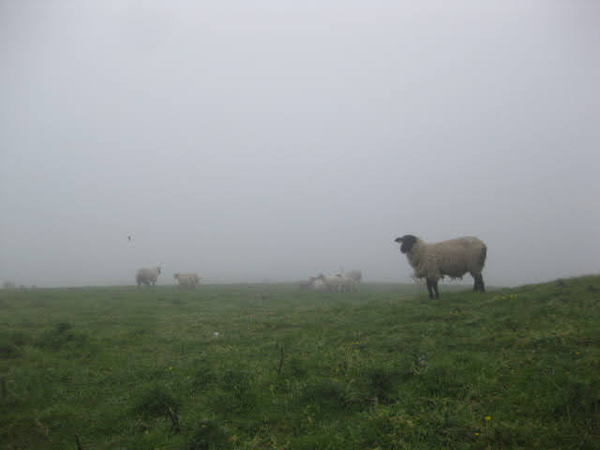
<figure class="image image-right"><img src="https://irishstudies.nd.edu/assets/665144/grace_fuchs_sheep.jpg" alt="White sheep with a black face stands on a green, grassy hill in heavy fog with other sheep in the distance." width="600" height="450">
<figcaption>Sheep graze in an Irish pasture. Photo by Grace Fuchs.</figcaption>
</figure>
<p>Meanwhile, Ireland is currently ranked second in global food security, according to the latest Global Food Security Index. In the Food Vision 2030 strategy, set by the Department of Agriculture, Food and the Marine, the Irish government set goals for rapid sustainable development of farms, while also following the EU Common Agriculture Policy (CAP), allowing for advancement of trade and the growth of agricultural markets. Their efforts — primarily in dairy and livestock — generated a significant surplus, reported by Teagasc research. While Ireland is limited in biodiversity, a surge in focus for sustainable and regenerative agriculture shows efforts to bridge the gap between carbon efficient agriculture and biodiversity. The focus on local products, and increasing the sustainability of these markets allows for Ireland to continue to have usable land, diminishing the effects of climate change on the agricultural markets.</p>
<p>When comparing tariff structures, Ireland is more insulated from some market shocks. The CAP allows for Ireland to be less impacted by market volatility, as the EU allows for free trade of products, supports income, market measures, and environmental conditions, which means geopolitical actions will not as severely impact Ireland as the US. Ireland is certainly not perfect when it comes to agriculture, with farmers recently protesting rising fuel costs and cost-of-living pressures. However, Ireland recognizes farming as a national strategic concern, linking food security, sustainability, export strength, and rural life as connected issues.</p>
<p>US political focus has shifted to focus on corporations, trade policy, and urban voters. The lesson Ireland shows the US is that farming is a national security issue, requiring thoughtful policies intended to strengthen rural life, promote sustainability, and increase market independence in agriculture..</p>
<h2>Soft power works</h2>
<p>The last aspect I feel the US should learn from Ireland is regarding soft power. When the US cut USAID funding it meant that massive programs designed to maintain the US as a strong ally for the world were severed. In the second Trump administration, trust has significantly decreased. While America seeks to use soft power in terms of culture, primarily it seeks military strength and traditional hard power. This methodology has resulted in staggeringly low approval ratings, with a poll by the European Council on Foreign Affairs finding that only one in 15 Europeans view the US as an ally. For a country based on exporting ideals, the decline in soft power has come at a cost.</p>
<p>Meanwhile, Ireland's approach to neutrality has gained international favor, and their soft power — from exporting St. Patrick’s Day, to Guinness, has been remarkably favorable. More than 70 million people worldwide claim Irish heritage, a key point in helping Ireland have a strong global stage. By exporting diplomats on St. Patrick’s Day, and leveraging its history as a non-imperial nation, the exportation of Ireland via soft power has been particularly successful. Their lack of significant military prowess points to this as well. Without force, Ireland has shaped itself as a diplomatic weapon, and a strong ally to many in the UN. It serves as an example of why soft power is so important to maintaining global relations.</p>
<p>The US should relearn why we were so influential. We did not simply export products, but ideas and values. Military strength is important, and encouraging others to increase defense spending is critical, but influence is not just economic and military. Sports — such as the World Cup — help show international fans what American culture is, from music to landscapes to food. A stronger emphasis must be placed on soft power and its exportation. Like the Irish, America has the ability to export its culture to encourage diplomacy. We should do so again.</p>
<p><strong>Read Grace Fuchs’ second blog post, <a href="https://irishstudies.nd.edu/news/what-america-and-ireland-can-learn-from-each-other/">“What Ireland can learn from America.”</a></strong></p>]]>
    </content>
    <link rel="enclosure" type="image/jpeg" href="https://irishstudies.nd.edu/assets/665147/grace_fuchs_deerfield_residence_3x2.jpg" title="Smiling woman in patterned dress, white blazer, glasses before a white building with American flags and bunting."/>
    <author>
      <name>Grace Fuchs</name>
    </author>
  </entry>
  <entry>
    <id>tag:irishstudies.nd.edu,2005:News/182029</id>
    <published>2026-05-13T11:17:00-04:00</published>
    <updated>2026-05-26T11:17:58-04:00</updated>
    <link rel="alternate" type="text/html" href="https://irishstudies.nd.edu/news/connecting-notre-dames-irish-community-the-wild-geese-project/"/>
    <title>Connecting Notre Dame’s Irish community: The Wild Geese Project</title>
    <summary type="text">
      <![CDATA[To help students, faculty and staff from Ireland feel more at home on campus, the Keough School’s Keough-Naughton Institute for Irish Studies has created a welcoming network of support. ]]>
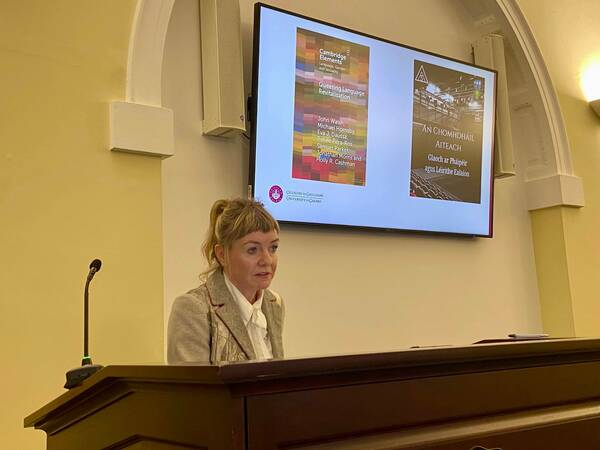
    </summary>
    <content type="html">
      <![CDATA[<figure class="image image-right"><img src="https://keough.nd.edu/assets/659288/original/wild_geese_photo.jpg" alt="Eight smiling students pose on a dark sports field. One is on shoulders, while others hold a green, white, and orange Irish flag." width="1364" height="908">
<figcaption>Students from the Notre Dame Gaelic Athletic Association, a club whose members play the ancient Irish sports of hurling and Gaelic football on campus.</figcaption>
</figure>
<p>For a small but notable subset of Notre Dame’s population, being “Irish” is more than just a mascot or a historic nickname — it’s a living, breathing identity. But for students moving from Ireland to South Bend for their college years, the transition to Notre Dame involves leaving behind family, community and the familiar comforts and traditions of home.</p>
<p>To help Irish students, as well as faculty and staff from Ireland, feel more at home on campus, the Keough School’s Keough-Naughton Institute for Irish Studies created The Wild Geese Project. Drawing inspiration from the historic “Wild Geese” — Irish soldiers and emigrants of the 17th and 18th centuries — the group provides a welcoming network of support for Notre Dame community members from Ireland.</p>
<h2>Watch: the Wild Geese Project</h2>
<p>Watch the video below to learn more about the Wild Geese Project including everything from its competitive Gaelic sports matches to lively conversation in the Irish language.</p>
<p><iframe width="853" height="478" src="https://www.youtube.com/embed/GXYL6euS-yk" allowfullscreen="allowfullscreen"></iframe></p>
<p class="attribution">Originally published by <span class="rel-author">Renée LaReau</span> at <span class="rel-source"><a href="https://keough.nd.edu/news-and-events/news/connecting-notre-dames-irish-community-the-wild-geese-project/">keough.nd.edu</a></span> on <span class="rel-pubdate">May 12, 2026</span>.</p>]]>
    </content>
    <link rel="enclosure" type="image/jpeg" href="https://irishstudies.nd.edu/assets/660675/wild_geese_photo.jpg" title="Eight smiling students pose on a dark sports field. One is on shoulders, while others hold a green, white, and orange Irish flag."/>
    <author>
      <name>Renée LaReau</name>
    </author>
  </entry>
  <entry>
    <id>tag:irishstudies.nd.edu,2005:News/181422</id>
    <published>2026-05-05T12:42:00-04:00</published>
    <updated>2026-05-05T12:49:42-04:00</updated>
    <link rel="alternate" type="text/html" href="https://irishstudies.nd.edu/news/from-artifacts-to-insight-students-discover-irish-history-through-special-collections/"/>
    <title>From artifacts to insight: Students discover Irish history through library’s special collections</title>
    <summary type="text">
      <![CDATA[Sometimes the best way to learn about history is by focusing on a single artifact. A letter printed in a newspaper, a piece of sheet music, a journal, or a novel can easily become a window into a broader historical narrative.]]>
    </summary>
    <content type="html">
      <![CDATA[<p>Sometimes the best way to learn about history is by focusing on a single artifact.</p>
<p>A letter printed in a newspaper, a piece of sheet music, a journal, or a novel can easily become a window into a broader historical narrative. That was the idea behind the “Adopt an Artifact” research project in this spring’s “Irish in America” class.</p>
<blockquote>
<p>“We wanted to bring collections into the curriculum and give undergraduates the opportunity to work with primary-source materials,” said <a href="https://directory.library.nd.edu/directory/employees/mknight2">Matthew Knight</a>, Irish studies librarian, curator, and head of <a href="https://rarebooks.library.nd.edu/">Rare Books &amp; Special Collections (RBSC)</a> in the Hesburgh Libraries.</p>
</blockquote>
<p>The class, co-taught by Matthew Knight and <a href="https://irishstudies.nd.edu/scholars/visiting-scholars/visiting-faculty-fellows/jennifer-knight/">Jennifer Knight</a>, visiting associate teaching professor in the Keough School of Global Affairs’ <a href="https://irishstudies.nd.edu/">Keough-Naughton Institute for Irish Studies</a>, examines the migration and history of Irish people and their descendants in America.</p>
<p>“This class unites the classroom experience with the Libraries’ holdings,” Jennifer said. “It is a traditional history course with lectures based on thematic narratives regarding the history of the Irish in America, but students also choose an item from the collection and use it as a primary source for their own research.”</p>
<p>Matthew and Jennifer see adopting an artifact as a way for students to feel more personally connected to the history they are studying.</p>
<blockquote>
<figure class="image image-left"><img src="https://conductorshare.nd.edu/assets/658475/04162026_irish_in_america_class16.jpg" alt="Smiling woman in dark green dress and man in dark jacket stand Rare Books &amp; Special Collections." width="600" height="400"></figure>
<p>“It helps you explore the broader history by giving you a chance to choose an object that fits your interests,” senior philosophy and theology major Alex Mitchell said. “You are also directing your own research, so it teaches you responsibility as you take part in the historical process.”</p>
</blockquote>
<p>Early in the semester, students were introduced to holdings from RBSC’s world-class Irish Studies Collection. Some adopted the pieces on display, while others selected items that aligned with personal interests.</p>
<p>“In high school, when I thought about what it would be like to be a history major, this is what I would envision,” senior Allison Willner said.</p>
<p>A strategic management, marketing, and history major, Willner adopted a piece of sheet music titled “The Lament of the Irish Emigrant.”</p>
<p>“I really love music and learning the stories behind it,” she said. “Studying the story behind this piece made me feel like an actual historian.”</p>
<figure class="image image-right"><img src="https://conductorshare.nd.edu/assets/658474/04162026_irish_in_america_class11_copy.jpg" alt="Young man in a black floral shirt and glasses uses a tool to examine an open book on a book cradle" width="300" height="434"></figure>
<p>In addition to writing a paper about their adopted object, students were tasked with creating a museum card and presenting their findings to the class at a student conference held at RBSC at the end of the term.</p>
<blockquote>
<p>“I really try to avoid classes where students only produce something that only I will read,” Jennifer said. “I’m always looking for ways to give them something extra to take away. In this case, it’s a conference they can put down on their CV.”</p>
</blockquote>
<p>By uniting the classroom experience with primary source materials, Matthew and Jennifer hope to create a class experience that leaves a lasting impact on students and encourages a deeper, more personal connection to history.</p>
<p>“They’re not just doing show-and-tell or a book report — this is the foundation for possible broader research or even a dissertation,” Matthew said. “It starts with an interest in one object. That interest fosters intellectual curiosity, which then turns into a passion.”</p>]]>
    </content>
    <link rel="enclosure" type="image/jpeg" href="https://irishstudies.nd.edu/assets/658678/04162026_rep_irish_in_america_class18.jpg" title="Two young women one in white speaks, gesturing at an open manuscript. Another in pink examines a book."/>
    <author>
      <name>Becky Malewitz</name>
    </author>
  </entry>
  <entry>
    <id>tag:irishstudies.nd.edu,2005:News/181299</id>
    <published>2026-04-29T15:17:00-04:00</published>
    <updated>2026-05-19T09:45:51-04:00</updated>
    <link rel="alternate" type="text/html" href="https://irishstudies.nd.edu/news/experts-discuss-european-resilience-from-orbans-defeat-to-the-trump-security-threat/"/>
    <title>Experts discuss European resilience, from Orbán's defeat to the Trump security threat</title>
    <summary type="text">
      <![CDATA[Contesting the narrative of decline, Irish scholar Brigid Laffan argues Europe is as rich as the US (minus the top 1%) and is hardening its defenses for 2030.]]>
    </summary>
    <content type="html">
      <![CDATA[<figure class="image image-right"><img src="https://keough.nd.edu/assets/657848/original/brigid_laffland_and_rory_finnin_notre_dame.webp" alt="Rory Finnin, a white-haired man in a grey suit, speaks, holding a book. Brigid Laffan, a blonde woman in a red suit, smiles, holding papers." width="1600" height="1067">
<figcaption>Rory Finnan, a professor of Ukrainian studies at the University of Cambridge and Brigid Laffan, an emeritus professor at the European University Institute discussed European geopolitics at an April 16 Dean's Forum event.</figcaption>
</figure>
<p>Europe is navigating a complex period of profound change marked by democratic strain, geopolitical instability and renewed questions of identity and solidarity. These challenges were the core focus of the April 16 Keough School of Global Affairs Dean's Forum on Global Affairs event, "Europe in a Time of Rupture." The discussion featured Brigid Laffan, a leading scholar of European integration, and Rory Finnin, an expert on culture and identity in Ukraine.</p>
<p>In her welcome remarks, Keough School Dean Mary Gallagher stressed that these challenges are "not distant concerns, but urgent realities shaping Europe and the wider world, including the United States.”</p>
<p>Finnin began the conversation by referring to April 12 election results in Hungary, where long-serving prime minister Viktor Orbán was decisively defeated by Péter Magyar of the opposition Tisza Party. This victory, following similar election results in Poland in 2023, represented a rejection of democratic backsliding, Finnin said.</p>
<p>Laffan characterized the Hungarian election result as an "earthquake election" for both Hungary and Europe. While Orbán had used the period following the 2010 Eurozone crisis to silently capture and reframe the Hungarian state and society, his decisive defeat was a "massive societal rejection" of Orbán, she said, who failed to deliver economically and contributed to a "very corrupt state and society."</p>
<p>Crucially, Laffan said, the election results showed that authoritarianism operating within systems "scaffolded" by NATO and EU membership has limits. Because an EU member state cannot suppress political alternatives indefinitely, electoral defeat, rather than coercive regime change, is a more likely end for such governments. She concluded that the Hungarian result was a "major setback for authoritarians in Europe," putting leaders such as Slovakian Prime Minister Robert Fico in an "uncomfortable place."</p>
<figure class="image image-right"><img src="https://keough.nd.edu/assets/657849/original/brigid_laffan_notre_dame.webp" alt="Brigid Laffan, a blonde woman in a red suit and patterned teal shirt sits smiling widely, holding papers. A microphone is clipped to her lapel." width="1200" height="800" loading="lazy">
<figcaption>Brigid Laffan</figcaption>
</figure>
<p>Finnin and Laffin also discussed the threat to European security posed by an aggressive Russia. Finnin warned that Europe is under constant attack via Russian hybrid warfare, including sabotage of industries, targeted assassinations, and attacks on public infrastructure. He cited former NATO Secretary General George Robertson's recent warning: "We are underprepared. We are under attack. We are not safe. Britain's national security and safety is in peril.”</p>
<p>Laffan said that after decades of enjoying a "peace dividend" and viewing war in Europe as impossible, the full-scale invasion of Ukraine in 2022 was a "palpable shock" that forced Europe to confront the reality of the Russian threat. She differentiated the threat perception between the "front line" states — such as the Baltic states — who "have no illusions," and countries in the south such as Spain and Italy. Despite the slow response, Brussels and European capitals are now working daily to build defense and security capability, she said, aiming to be ready by 2030.</p>
<p>Laffan pointed to Ukraine as an extraordinary asset, noting that the country’s civil society has driven technological innovation, particularly in drone and robotic warfare. Furthermore, an EU-member Ukraine will be a “battle-hardened country with a very strong military," she said, ensuring Europe will not remain defenseless.</p>
<h2>On Irish neutrality</h2>
<p>Finnin asked Laffan about her native Ireland, specifically the tenability of its long-standing neutrality. Laffan described this stance as both a "disgrace" and a self-deception. She argued that Ireland's historical neutrality was only possible because it was geographically situated next to the "global imperial power" and was too costly to invade during World War II, a history that has led to a mindset that doesn't take defense and security seriously.</p>
<p>In reality, Laffan said, Russian naval spy vessels have been spotted in Irish waters patrolling areas containing vital communication cables, while the Irish Navy has only four sea-worthy vessels. Laffan highlighted the country's low defense spending (0.24% of its gross domestic product) and its military size of fewer than 8,000 individuals combined. She stressed that Ireland should cease debating joining military alliances, for which it is entirely unprepared and would not meet minimum NATO standards, and instead focus on cooperating with neighbors to secure the Atlantic seaboard.</p>
<h2>Contesting the narrative of decline</h2>
<figure class="image image-right"><img src="https://keough.nd.edu/assets/657862/original/rory_finnan_speaking.webp" alt="Rory Finnan, a white-haired man in grey suit, glasses speaks while holding a pen and notebook. Screen shows Keough-Naughton Institute." width="1200" height="800" loading="lazy">
<figcaption>Rory Finnin</figcaption>
</figure>
<p>Addressing the "amorphous, constantly shifting threat to the west from Washington," Finnin quoted a US National Security Strategy document claiming that the European Union "undermine[s] political sovereignty" and warning that if current trends continued, the continent would be "unrecognizable in 20 years or less."</p>
<p>Laffan confirmed that European capitals understand that the Trump administration is "no friend of Europe," and that the transatlantic alliance is fraying. She contested the U.S. narrative of decline, which is often predicated on the EU's slipping share of global gross domestic product. Laffan argued that if the top 1 percent of U.S. income earners are excluded, Europe is "just as rich as the U.S." and boasts a far stronger, more equitable distribution of income and welfare protection.</p>
<p>While acknowledging that Europe lags technologically and faces a major investment gap due to a cultural tendency to save rather than invest, Laffan disagreed with the idea of a European decline. She described migration as a "very challenging issue" and a political wedge, noting that the income gap across the Mediterranean and the weaponization of migration by Russia have led to a crisis of "hypermobility" that post-war refugee protection treaties were not designed to handle.</p>
<h2>The ‘weird resilience’ of solidarity</h2>
<p>The speakers concluded by discussing European solidarity. Laffan asserted that solidarity between EU-member states is robust, though thinner than that found in a nation-state. The first pillar of this solidarity is found in significant fiscal transfers, specifically cohesion funds, which transfer wealth from "core Europe" to poorer members like Poland and Ireland. Other pillars include free mobility, mutual support processes during crises, and the unity demonstrated during Brexit.</p>
<p>Laffan recalled that when the UK decided to leave the EU, 26 countries stood firm behind Ireland to prevent the re-establishment of a hard border that could have led to renewed violence. This demonstration of collective unity, Laffan said, illustrates what a recent Financial Times article described as the EU’s "weird resilience." The political system, "shouldn't work, but it does," Laffan said. “And it survives by certain norms. And also the one thing the EU never does is it never leaves the negotiation table.”</p>
<p>Laffan noted that current geopolitical crises are binding the system together, suggesting the EU’s true working motto, surpassing "unity in diversity," is what former Italian Prime Minister Mario Draghi famously said about implementing the euro: "Whatever it takes."</p>
<p>The EU is a "tougher, more resilient political system than we think," Laffan said. “And it survives.”</p>
<p>Brigid Laffan is an emeritus professor at the European University Institute, the chancellor of the University of Limerick, and president of the European Policy Centre in Brussels. She is the author of “The EU's Response to Brexit, United and Effective.”</p>
<p>Rory Finnin, a professor of Ukrainian studies at the University of Cambridge, founded the Cambridge Ukrainian Studies Program. He is the author of the internationally acclaimed book “Blood of Others: Stalin's Crimean Atrocity, and The Poetics of Solidarity.” He is currently a visiting professor at Notre Dame’s Nanovic Institute for European Studies.</p>
<p>The Dean’s Forum event was presented in partnership with the <a href="https://irishstudies.nd.edu/">Keough-Naughton Institute for Irish Studies</a> and the <a href="https://nanovic.nd.edu/">Nanovic Institute for European Studies</a>, part of the <a href="https://keough.nd.edu/">Keough School of Global Affairs</a>.</p>
<p>The <a href="https://keough.nd.edu/news-and-events/events/deans-forum-on-global-affairs/">Dean's Forum on Global Affairs</a> is designed to bring world leaders into conversation with Notre Dame students, faculty and the broader community around current challenges shaping global affairs.</p>
<h2>Watch: Deans Forum Brigid Laffan "Europe in a Time of Rupture"</h2>
<p><a class="video" href="https://www.youtube.com/watch?v=AJ8_WkPphSs"><img src="https://keough.nd.edu/assets/657884/original/deans_forum_keough_school_brigid_laffan_youtube_cover_image.webp" alt="Sepia photo of Notre Dame's Golden Dome framed by trees, next to a dark blue panel with Keough School event details." width="600" loading="lazy"></a></p>
<div class="play"> </div>
<p class="attribution">Originally published by <span class="rel-author">Renée LaReau</span> at <span class="rel-source"><a href="https://keough.nd.edu/news-and-events/news/experts-discuss-european-resilience-from-orbans-defeat-to-the-trump-security-threat/">keough.nd.edu</a></span> on <span class="rel-pubdate">April 28, 2026</span>.</p>]]>
    </content>
    <link rel="enclosure" type="image/jpeg" href="https://irishstudies.nd.edu/assets/658228/brigid_laffland_and_rory_finnin_notre_dame_1_.jpg" title="Rory Finnin, a white-haired man in a grey suit, speaks, holding a book. Brigid Laffan, a blonde woman in a red suit, smiles, holding papers."/>
    <author>
      <name>Renée LaReau</name>
    </author>
  </entry>
  <entry>
    <id>tag:irishstudies.nd.edu,2005:News/180350</id>
    <published>2026-04-10T12:48:00-04:00</published>
    <updated>2026-05-05T12:48:28-04:00</updated>
    <link rel="alternate" type="text/html" href="https://irishstudies.nd.edu/news/for-and-against-a-united-ireland-book-tour/"/>
    <title>‘For and Against a United Ireland’ wins prestigious book prize, draws crowds on U.S. tour</title>
    <summary type="text">
      <![CDATA[The book, which was commissioned by ARINS (Analysing and Researching Ireland North and South), received the Christopher Ewart-Biggs Memorial Prize. The award recognizes work that encourages peace and reconciliation in Ireland.]]>
    </summary>
    <content type="html">
      <![CDATA[<p class="lede">A book commissioned by a University of Notre Dame partnership with the Royal Irish Academy recently received the Christopher Ewart-Biggs Memorial Prize, a prestigious literary award for work that encourages peace and reconciliation in Ireland.</p>
<figure class="image image-right"><img src="https://irishstudies.nd.edu/assets/657367/for_against_nyc_34.jpg" alt='Two smiling men on a stage with an "ARINS" screen. An older man in a brown suit holds papers. A bearded man wears a blue vest.' width="600" height="400">
<figcaption>Fintan O’Toole, left, and Sam McBride speak March 16 at the Irish Arts Center in New York.</figcaption>
</figure>
<p>The book, <a href="https://irishstudies.nd.edu/news/arins-book-for-and-against-a-united-ireland/">“For and Against a United Ireland,”</a> emerged from <a href="https://www.ria.ie/research-programmes/arins/">ARINS (Analysing and Researching Ireland North and South)</a> — a joint academic project of the <a href="https://irishstudies.nd.edu/">Keough-Naughton Institute for Irish Studies</a> in Notre Dame’s Keough School of Global Affairs and the Royal Irish Academy. It was written by Fintan O’Toole of The Irish Times and Sam McBride of the Belfast Telegraph, two of the island’s most distinguished journalists.</p>
<p>The literary prize is named in honor of <a href="https://ewartbiggsprize.org.uk/past-winners/2024-2025-prize">Christopher Ewart-Biggs</a>, a former British ambassador to Ireland who was murdered by the IRA in 1976. The prize is awarded biannually to recognize work that promotes peace and reconciliation in Ireland, encourage greater understanding between the peoples of Britain and Ireland, and support closer cooperation between European partners.</p>
<p>In “For and Against a United Ireland,” O’Toole and McBride don’t just take one side in the debate and argue with each other. Each author independently wrote his own chapter in favor of unification and his own chapter against unification. That structure made the book a balanced conversation about the issues that voters on the island would need to consider if there ever were a referendum on removing the border between Ireland and Northern Ireland.</p>
<p>“This award means a great deal not only because it comes from such a distinguished panel of judges but because the ethos of this prize mirrors our motivation for this book,” McBride said. “We were seeking not to change people’s minds, but to open them.”</p>
<p>O’Toole said he vividly remembers the horror of Ewart-Biggs’ murder a half-century ago.</p>
<p>“The Ewart-Biggs Prize has always seemed to me a particularly graceful refusal of despair. It insists on the possibilities of both rational engagement with, and imaginative transcendence of, our shared dilemmas,” O’Toole said.</p>
<p>“Sam and I have hoped in a small way to reject the relentless polarization of contemporary politics,” he added, “and to show that even on highly emotive topics it is possible to have respectful discussions that acknowledge that those with whom one disagrees might have things to say that are worth listening to.”</p>
<h2>‘For and Against’ on the road</h2>
<p>The Ewart-Biggs Prize was announced on March 18 in Belfast while O’Toole and McBride happened to be in the United States speaking to large crowds on a five-city tour.</p>
<p>The pair presented their arguments for and against a united Ireland to audiences in Chicago, New York, and Washington, DC, as well as on the campuses of Boston College and Princeton University.</p>
<figure class="image image-default"><img src="https://irishstudies.nd.edu/assets/658184/fullsize/for_against_chicago_collage.jpg" alt="Two men lead a panel discussion on Notre Dame's campus. An audience member asks a question, followed by a book signing." width="1200" height="800">
<figcaption>Chicago, March 12</figcaption>
</figure>
<p>The Chicago Club was the first stop on the U.S. tour promoting “For and Against a United Ireland.” O’Toole and McBride discussed the issues, answered audience questions, and signed copies of the book.</p>
<figure class="image image-default"><img src="https://irishstudies.nd.edu/assets/658185/fullsize/for_against_nyc_collage.jpg" alt="Panel discussion on 'For and Against a United Ireland' at the Irish Arts Center, with Fintan O'Toole, Sam McBride, and book signing." width="1200" height="800">
<figcaption>New York, March 14</figcaption>
</figure>
<p>O’Toole and McBride spoke to a packed theater on March 14 at the Irish Arts Center in New York.</p>
<figure class="image image-right"><img src="https://irishstudies.nd.edu/assets/657385/for_against_dc_emma_pengelly.jpg" alt="Woman in navy blazer speaks at podium. Banners behind her show Notre Dame's Golden Dome and Washington Ireland Program." width="600" height="400">
<figcaption>Deputy First Minister of Northern Ireland Emma Little-Pengelly</figcaption>
</figure>
<p>Then they continued on to Washington, D.C., where they were part of the slate of gatherings planned in the capital each year around St. Patrick’s Day.</p>
<p>A standing-room-only crowd filled Notre Dame’s Washington Office on March 16 for an event held in partnership with the <a href="https://wiprogram.org/news-event/2026-wip-emerging-leaders-and-wip-academy-announced-in-washington-dc/">Washington Ireland Program</a>.</p>
<p>Several public officials attended the D.C. event. The list included Deputy First Minister of Northern Ireland Emma Little-Pengelly, who is an alumna of the Washington Ireland Program, as well as Secretary of State for Northern Ireland Hilary Benn and U.S. Rep. Tim Kennedy of New York.</p>
<p>The conversation between O’Toole and McBride was moderated by Aoife Joy Keogh and Luke Teggert, two recent alumni of the Washington Ireland Program.</p>
<figure class="image image-default"><img src="https://irishstudies.nd.edu/assets/658183/fullsize/for_against_dc_collage.jpg" alt="A diverse audience watches speakers at a Washington Ireland Program event, including a panel and a man at a podium." width="1200" height="800">
<figcaption>Washington, March 16</figcaption>
</figure>
<p>O’Toole and McBride finished out their U.S. tour with events hosted by the Irish Institute of Boston College on March 18 and Princeton University’s Fund for Irish Studies on March 20.</p>
<p><strong>“For and Against a United Ireland” was published by the <a href="https://shop.ria.ie/en-us/products/for-and-against-a-united-ireland">Royal Irish Academy</a> in fall 2025 and by <a href="https://undpress.nd.edu/9780268211189/for-and-against-a-united-ireland/">Notre Dame Press</a> earlier this year.</strong></p>]]>
    </content>
    <link rel="enclosure" type="image/jpeg" href="https://irishstudies.nd.edu/assets/657367/for_against_nyc_34.jpg" title="Two smiling men on a stage with an &quot;ARINS&quot; screen. An older man in a brown suit holds papers. A bearded man wears a blue vest."/>
    <author>
      <name>Keough-Naughton Institute</name>
    </author>
  </entry>
  <entry>
    <id>tag:irishstudies.nd.edu,2005:News/180696</id>
    <published>2026-04-09T12:15:00-04:00</published>
    <updated>2026-04-09T12:23:06-04:00</updated>
    <link rel="alternate" type="text/html" href="https://irishstudies.nd.edu/news/robert-osullivan-society-for-the-study-of-nineteenth-century-ireland-2025-essay-prize/"/>
    <title>Keough-Naughton postdoc Robert O’Sullivan receives award for essay on 19th-century Ireland</title>
    <summary type="text">
      <![CDATA[O’Sullivan, a political and social historian, was recognized by the Society for the Study of Nineteenth-Century Ireland for an article he published in Irish Historical Studies.]]>
    </summary>
    <content type="html">
      <![CDATA[<p class="lede">Robert O’Sullivan, a postdoctoral research associate at the Keough-Naughton Institute for Irish Studies, has been awarded the Society for the Study of Nineteenth-Century Ireland’s 2025 essay prize.</p>
<figure class="image image-right"><img src="https://irishstudies.nd.edu/assets/655624/robert_osullivan_3x2.jpg" alt="A man with light brown hair, blue eyes, and a beard, wearing a maroon collared shirt, smiles slightly in a restaurant." width="600" height="400">
<figcaption>Robert O’Sullivan</figcaption>
</figure>
<p>The annual award, which is open to early-career researchers in all disciplines, recognizes a piece of scholarship that makes the greatest contribution to the study of nineteenth-century Ireland, that demonstrates an awareness of issues in related disciplines inside and outside of Irish studies more broadly, and that demonstrates the excellence of scholarship on nineteenth-century Ireland to the wider scholarly community.</p>
<p>O’Sullivan is a political and social historian of nineteenth-century American and Irish history. He received the essay prize for his article, <a href="https://doi.org/10.1017/ihs.2024.43">“The Irish-American press, the Franco-Prussian War and Irish-American identity in the postbellum United States, 1870–71,”</a> published in <em>Irish Historical Studies</em>.</p>
<p>The society’s committee commented on his article:</p>
<blockquote>
<p>The judges were very impressed by the article’s innovative transnational approach and what it reveals about how Irish American actors used international events to articulate political positions and shape diasporic identity. Committee members also commended the clarity of its argument and the nuanced, effective use of evidence to support an original contribution to Irish and diasporic history.</p>
</blockquote>
<p><a href="https://irishstudies.nd.edu/scholars/visiting-scholars/visiting-faculty-fellows/robert-osullivan/">O’Sullivan</a> earned his doctorate at the University of Cambridge and joined the Keough-Naughton Institute as a postdoc in January 2025. He is currently working on his first book — a monograph that explores the writings and activism of a series of Irish-American newspaper editors and their readers, and examines how they contributed to the process through which Irish immigrant, diasporic identity took root in the United States by engaging with political developments across the globe.</p>
<p><a href="https://ssnci.org/society-for-the-study-of-nineteenth-century-ireland-annual-essay-prize/"><strong>Read the Society for the Study of Nineteenth-Century Ireland’s announcement. </strong></a></p>]]>
    </content>
    <link rel="enclosure" type="image/jpeg" href="https://irishstudies.nd.edu/assets/655624/robert_osullivan_3x2.jpg" title="A man with light brown hair, blue eyes, and a beard, wearing a maroon collared shirt, smiles slightly in a restaurant."/>
    <author>
      <name>Keough-Naughton Institute</name>
    </author>
  </entry>
  <entry>
    <id>tag:irishstudies.nd.edu,2005:News/180240</id>
    <published>2026-03-27T12:09:00-04:00</published>
    <updated>2026-03-27T16:09:16-04:00</updated>
    <link rel="alternate" type="text/html" href="https://irishstudies.nd.edu/news/keough-naughton-institute-sponsors-the-first-comortas-larchet/"/>
    <title>Returning home: Keough-Naughton Institute sponsors the first Comórtas Larchet</title>
    <summary type="text">
      <![CDATA[The Feis Ceoil has staged its first Comórtas Larchet for choral work in the Irish language. “The more exposure that we can give children in Ireland to choral singing the richer life is,” Professor Brian Ó Conchubhair said.]]>
    </summary>
    <content type="html">
      <![CDATA[<p class="lede">In a new partnership the Feis Ceoil has staged its first Comórtas Larchet for choral work in the Irish language. The competition was sponsored by the University of Notre Dame’s Keough-Naughton Institute for Irish Studies with the premiere held Thursday, March 19, in the RDS Grand Hall in Dublin.</p>
<figure class="image image-right"><img src="https://irishstudies.nd.edu/assets/654140/wesley_college_como_rtas_larchet_winners_with_composer_norah_walsh.jpg" alt="Triumphant students in navy and red uniforms, with two adults, hold a silver trophy in an old stone church with a stained glass window." width="600" height="427">
<figcaption>Comórtas Larchet winner Wesley College with composer Norah Constance Walsh</figcaption>
</figure>
<p>Post-primary choirs were invited to compete in performing Norah Constance Walsh’s new setting of the poem “Filleadh ar an gCathair” by Ailbhe Ní Ghearbhuigh, a contemporary poet from Tralee in Co. Kerry.</p>
<p>In this inaugural competition, the first prize of €750 and Certificate to Conductor went to Wesley College (conductor Helen Doyle) and second prize to King’s Hospital (conductor Ciarán Kelly).</p>
<p>Laura Gilsenan has been CEO of Feis Ceoil for almost two decades, having joined the organization from a human resources role as it transitioned into a company.</p>
<p>Gilsenan said that this year is the 130th anniversary of Feis Ceoil. “Composition has been part of Feis Ceoil since the very beginning,” she says. “We wanted to do a couple of things that would reignite some of the fundamental principles of why the Feis Ceoil was set up in the first place. There is a very strong composition tradition in Ireland.”</p>
<p>Founded in 1896 by Dr. Annie Patterson from Lurgan, Co. Armagh, a composer, organist and Gaelic League member, the Feis Ceoil takes place annually with 200 different competitions over March and June, and almost 5,000 students from as young as age seven performing for international adjudicators.</p>
<p>Ireland’s premier music competition, the Feis is a rite of passage for classical musicians in Ireland, having turned out many notable performers including singers Claudia Boyle, Tara Erraught, Celine Byrne, pianists John O’Conor and Finghin Collins, and violinist Cora Venus Lunny.</p>
<p>Going further back, a 22-year-old James Joyce won (to his disappointment) the bronze medal in the tenor solo competition in 1904, having been persuaded by gold-medal winner Count John McCormack to take part. Joyce’s bronze medal is in the possession of dancer Michael Flatley.</p>
<p>Irish rebel Eamonn Ceannt played uilleann pipes and adjudicated the piping competitions in 1915. Set to judge the competition again the following year, he was executed in Kilmainham Gaol in 1916 for his part in the Easter Rising.</p>
<p>The Feis has survived, says Gilsenan, because “the standard here is high. Adjudicators come from abroad, so people are not only being benchmarked against their peers, they’re being benchmarked internationally.”</p>
<p>Many participants go on to populate choirs, orchestras and opera houses in Europe and the US. “The vast majority of classical musicians working in Ireland have been through the Feis.” Of the competitions, “People find it hard to comprehend the scale of it,” says Gilsenan.</p>
<p>The founder’s vision was to revive Irish music through a classical repertoire and this is the key principle of the new Comórtas Larchet, named after the prominent Irish musician and teacher John F. Larchet.</p>
<p>Gilsenan may be busy with the hands-on running of the sprawling competitions, while keeping the company afloat, but she has also been a choral singer her whole life. When selecting the poem, “I had an idea what might be of interest to people of the level we’re looking at, aged between 14 and 17.”</p>
<p>She says, “We noticed that the numbers of Irish-language choirs were going down. We thought we could introduce interesting choral repertoire in the Irish language that would hopefully reignite people’s passion for it.”</p>
<figure class="image image-default"><img src="https://irishstudies.nd.edu/assets/654139/fullsize/wesley_college_in_performance.jpg" alt="A student choir in dark uniforms faces a conductor in an old stone church with glowing circular lights, stained glass, and an organ." width="1200" height="859">
<figcaption>Wesley College in performance</figcaption>
</figure>
<h2>A ‘green wave’ of Irish-speaking musicians</h2>
<p>From the Belfast Irish-language rappers Kneecap to pop star CMAT (who mixes Irish-language lyrics in her latest album, “Euro-Country”) to bilingual artists like Lankum and Róis, there seems to be a “green wave” of Irish-speaking musicians shaping international taste.</p>
<p>“I think we’re lucky with Kneecap and those kinds of people creating an Irish-language resurgence,” says Gilsenan. “A bit of a zeitgeist that we have inadvertently tapped.”</p>
<p>The poem by Ní Ghearbhuigh, “Filleadh ar an gCathair,” translated as “Returning to the City,” is a vibrant and tactile celebration of coming home to the bustle, heat and petrol fumes of a beloved city. It is a rewriting of Máirtín Ó Direáin’s poem “The Islander” with many accolades, chosen as Ireland's EU Presidency poem in 2013 and shortlisted in 2015 for RTE's “A Poem for Ireland.”</p>
<p>Norah Constance Walsh is a composer, musician and the artistic director of Dublin-based choirs The Mellow Tonics and the Forget Me Nots. She is also a former Feis entrant who performed on piano, before setting aside her musical career for a while.</p>
<p>“My journey was a little bit unusual because I had a career as a corporate banker before I went back to do a degree in music,” says Walsh. “I’d always been a musician. When I decided I wanted to take a break from one career, I didn’t return to the other. Composition has always been something I’d wanted to do.”</p>
<p>Walsh has set the works of numerous poets to music, including Dermot Bolger, Catherine Ann Cullen, Moya Cannon, Peter Sirr and Tony Curtis, and has composed short operas alongside her career as a conductor and musical director for such televised events as the 2018 Papal visit. “Vocal works are a core part of my compositional output because I love the ability to communicate a narrative and a feeling,” she says.</p>
<p>First contacted by the Contemporary Music Centre, Walsh was involved in selecting the poem from a list of 10 compiled by Gilsenan and others, including Notre Dame’s Professor <a href="https://irishlanguage.nd.edu/people/brian-o-conchubhair/">Brian Ó Conchubhair</a>. Of receiving the commission, she says, “An initial reading inspires a lot of instant ideas and thoughts.”</p>
<p>“The text was a particularly good choice for the competition because it was written by a young adult and the themes are those of young adults, although they ring absolutely true with me as an older adult. I thought the fit was good, it’s about returning to the city, full of life and vitality. It was so relatable to younger people. I had an image of these rows of young singers coming back to the city full of life, and how they’ve missed it.”</p>
<p>The poem is about Bordeaux, where Ailbhe Ní Ghearbhuigh spent time, though anyone who has journeyed home from an airport through their city streets will find very personal resonances in the poem.</p>
<p>What Walsh most liked about it was “this idea of coming back to the city, instead of some pastoral landscape or tumultuous seas.”</p>
<p>“The language she uses in describing the elements of the city is beautiful and yet slightly crude in places. She’s talking about the heat of the city, the taste of sweat which she finds to be pleasant, the neon lights that are lighting up her heart, the song of the traffic. We normally associate traffic with noise, with negative adjectives. Also this idea that ‘preabann an Aimsir Láithreach,’ the present tense, is throbbing or pulsating.”</p>
<p>“I was delighted to have the opportunity to set a poem in Irish,” she adds. “My son went to a Gaelscoil, and we speak a little at home. It’s a very rich part of my heritage.”</p>
<figure class="image image-right"><img src="https://irishstudies.nd.edu/assets/654144/2026_feis_ceoil_cup.jpg" alt="Five smiling people, including a woman in a black dress holding a silver trophy, stand in a church with an ornate altar." width="600" height="481">
<figcaption>From left, adjudicator Oliver Hynes, conductor Helen Doyle, composer Norah Constance Walsh, Feis Ceoil CEO Laura Gilsenan, and presenter Pádhraic Ó Cuinneagáin</figcaption>
</figure>
<p>Gilsenan, who was involved in selecting the piece and in commissioning Walsh, hopes it may become part of the canon of repertoire in Irish choral singing. “When we come to next year we’ll hopefully have more people taking it up.”</p>
<p>She believes the Feis Ceoil has a greater reach than in fostering musical talent in its participants. “We are not only training musicians, but we’re training the audiences of the future as well. A lot of people come to music through their school choir or orchestra and hopefully retain a love of it.”</p>
<p>This year, along with the Comórtas Larchet, the Feis has added Community Choirs to its competitions. Ireland has a very strong choir culture, with long-running regional choir competitions and community choirs emerging throughout the country in recent years.</p>
<p>“There is a great benefit to people’s mental health with singing. A lot of people might have a memory of school choirs where they were told to mime because their voices weren’t strong enough, so to be able to participate fully is very empowering,” says Gilsenan.</p>
<p>“The sense of collaboration creates enormous well-being. Fostering that love of music will stay with people.”</p>
<h2>‘An iconic aspect of Irish culture’</h2>
<p>Ó Conchubhair is a faculty fellow at the Keough-Naughton Institute in Notre Dame’s <a href="https://keough.nd.edu/">Keough School of Global Affairs</a>. He has been a key figure in <a href="https://irishlanguage.nd.edu/">the revival of the Irish language</a>, and he was involved in selecting the poem and commissioning Walsh.</p>
<p>“The Keough-Naughton Institute is well known for its visual arts and academic support, and the Feis Ceoil seemed a natural extension,” he says.</p>
<p>“The Feis Ceoil is an iconic aspect of Irish culture that predates the formation of the Irish state. It has a unique selling point that captures that tension where you might ask is Irish identity part of the high European classical music tradition or is it closer to some form of wild exotic Sean Nós singing?”</p>
<p>For Ó Conchubhair, “Filleadh ar an gCathair” is “a modern classic text.”</p>
<p>“There is something about a child alone learning the words, lines and verses. Then their voice being subsumed by the music and group as they come together in society,” he says.</p>
<p>“The more exposure that we can give children in Ireland to choral singing the richer life is,” he believes. He is passionate about a tradition “intertwining music, composition, Irish language, performance, and cutting across genres.”</p>
<p>For Gilsenan, the partnership with the Keough-Naughton Institute has elevated the Feis to a high standard as it faces an uncertain future. Funded by the ESB for 10 years up to 2018, the Feis has since partnered with the RDS but received reduced funding. “If in the next 18 months we don’t get a committed funder we are simply not going to be able to continue,” says Gilsenan.</p>
<p>“The first thing people assume is that we’re government funded, we’re not,” she says. “The Arts Council doesn’t fund competitive organizations. Because we are 130 years old people just assume you’re there for the duration, which is understandable, but the reality is very different.”</p>
<p>Sponsorship from the Keough-Naughton Institute, says Gilsenan, “injected a little bit of self-belief when we needed it.”</p>
<p>The Feis is a mainstay of Irish culture, with a value that goes far beyond the pursuit of academic success, she believes. “In these years with kids being on their phones so much and having a short attention span, learning an instrument is especially important. It can still only be achieved exactly the same way as it was it was 100 years ago. You have to put in the hours, the focus and the dedication. There is no new technology to replace that.”</p>
<p><strong>Watch the performances from the Comórtas Larchet on the <a href="https://vimeo.com/1176967768">Feis Ceoil Vimeo channel</a>.</strong></p>]]>
    </content>
    <link rel="enclosure" type="image/jpeg" href="https://irishstudies.nd.edu/assets/654138/wesley_college_como_rtas_larchet_winners_with_composer_norah_walsh_3x2.jpg" title="A large group of cheering students in navy uniforms, many with raised fists, pose with a trophy in a stone church."/>
    <author>
      <name>Maggie Armstrong</name>
    </author>
  </entry>
  <entry>
    <id>tag:irishstudies.nd.edu,2005:News/180152</id>
    <published>2026-03-20T09:21:00-04:00</published>
    <updated>2026-03-20T09:31:21-04:00</updated>
    <link rel="alternate" type="text/html" href="https://irishstudies.nd.edu/news/arins-susie-deedigan-young-academy-ireland/"/>
    <title>ARINS Programme Manager Susie Deedigan joins Young Academy Ireland</title>
    <summary type="text">
      <![CDATA[Young Academy Ireland is an all-island network of early-career researchers and innovators. Deedigan is one of 21 new members from Ireland and Northern Ireland who were selected through a competitive process launched by the Royal Irish Academy.]]>
    </summary>
    <content type="html">
      <![CDATA[<p class="lede">Susie Deedigan, programme manager for ARINS (Analysing and Researching Ireland North and South), was recently selected to join <a href="https://www.ria.ie/young-academy-ireland/">Young Academy Ireland</a>, a prestigious all-island network of early-career researchers and innovators. She is one of 21 new members from Ireland and Northern Ireland who were selected after a competitive process launched by the Royal Irish Academy last year.</p>
<figure class="image image-right"><img src="https://irishstudies.nd.edu/assets/597985/susiedeedigan_2024.jpg" alt="A white woman wearing a black and gold dress poses for a portrait." width="600" height="600">
<figcaption>Susie Deedigan</figcaption>
</figure>
<p><a href="https://irishstudies.nd.edu/core-identity/director-and-staff/susie-deedigan/">Deedigan</a> is a historian who holds a Ph.D. from Queen’s University Belfast.</p>
<p>Her work with <a href="https://www.ria.ie/research-programmes/arins/">ARINS</a> — a joint academic project of the Keough-Naughton Institute for Irish Studies in the University of Notre Dame’s Keough School of Global Affairs and the Royal Irish Academy — combines historical scholarship with engagement across policy, public, and academic audiences. Based in Belfast, she contributes to policy engagement, co-produces podcast series, and organizes academic and public events.</p>
<p>Deedigan’s research examines women’s political activism, imprisonment, and cross-border networks in 20th-century Ireland.</p>
<p>Her scholarship includes a monograph in preparation that offers the first dedicated study of Irish female republican imprisonment during World War II. She has produced peer‑reviewed outputs on female activism in the 1940s, collaborative women’s networks across Ireland and Britain, and women’s political participation in Northern Ireland. She has held competitive grants and fellowships, including a visiting research fellowship at the University of California, Berkeley, and has presented at major international conferences and research seminars.</p>
<p>Lynn Scarff, executive director fo the Royal Irish Academy, said of the new Young Academy Ireland cohort, “Through YAI, we are investing not only in their professional development, but in their capacity to shape policy dialogue, foster interdisciplinary collaboration, and contribute meaningfully to the societal challenges facing Ireland and beyond.”</p>
<p><strong><a href="https://www.ria.ie/2026/03/12/young-academy-ireland-welcomes-21-new-members/">Read the full Young Academy Ireland announcement.</a></strong></p>]]>
    </content>
    <link rel="enclosure" type="image/jpeg" href="https://irishstudies.nd.edu/assets/653243/susiedeedigan_2024_3x2.jpg" title="A woman with long reddish-blonde hair and round glasses smiles gently. She has blue eyes and a nose piercing."/>
    <author>
      <name>Keough-Naughton Institute</name>
    </author>
  </entry>
  <entry>
    <id>tag:irishstudies.nd.edu,2005:News/180080</id>
    <published>2026-03-18T23:31:00-04:00</published>
    <updated>2026-03-18T23:36:02-04:00</updated>
    <link rel="alternate" type="text/html" href="https://irishstudies.nd.edu/news/india-and-ireland-conference-miranda-house-university-of-delhi/"/>
    <title>Shared histories of India and Ireland illuminated at Notre Dame conference in Delhi</title>
    <summary type="text">
      <![CDATA[The conference held at Miranda House, University of Delhi, explored the links between India and Ireland not only as parallel experiences, but also as shared experiences.]]>
    </summary>
    <content type="html">
      <![CDATA[<p class="lede">An international group of scholars gathered last week at Miranda House, University of Delhi, in India’s capital city for a series of roundtables dedicated to the theme of “India and Ireland: Shared Histories and Interconnected Pasts.”</p>
<p class="lede">The gathering was organized by <a href="https://irishstudies.nd.edu/scholars/visiting-scholars/visiting-faculty-fellows/jill-bender/">Jill Bender</a>, visiting associate professor at the <a href="https://irishstudies.nd.edu/">Keough-Naughton Institute for Irish Studies</a> in the University of Notre Dame’s Keough School of Global Affairs and associate professor of history at the University of North Carolina at Greensboro; <a href="https://global.nd.edu/about/people/dhiraj-mehra/">Dhiraj Mehra</a>, director for initiatives in India for Notre Dame Global; and Miranda House faculty members Sneh Jha and Ms. Madhu. The event drew remarkable support and interest from students and faculty of the host college, an international cohort of speakers, and the Embassy of Ireland, India.</p>
<figure class="image image-right"><img src="https://irishstudies.nd.edu/assets/652976/india_ireland_032026_ambassador_kevin_kelly.jpg" alt="An audience in green and orange chairs watches a speaker at a podium and panelists on a stage with a 'Miranda House' banner." width="600" height="400">
<figcaption>Ambassador of Ireland to India Kevin Kelly speaks at Miranda House.</figcaption>
</figure>
<p>Irish Ambassador to India Kevin Kelly inaugurated the proceedings with a reception at his official residence on the evening of March 9, followed by opening comments the next morning. In his remarks, Kelly acknowledged how the relationship between India and Ireland has been “created and complicated by colonialism” and by their respective relationships to Great Britain. The focus of the academic gathering, however, was on the many direct links between Ireland and India and on the movement of people from one country to the other throughout their shared histories. The ambassador added that the diasporas of both nations have been a source of strength for them at a global level and welcomed participants as they prepared to share research, artwork, and historical projects that examine the complex connections between the two countries.</p>
<p>The colloquium’s researchers took on the organizers’ call to illuminate both popular and lesser-known aspects of Indian and Irish ties. In recent years, scholars have not only explored these links as parallel experiences, but also as shared experiences — recognizing how these connections or networks were forged and maintained and emphasizing the ways in which these relations were mutually constituted and informed by distinct but analogous experiences of British rule. Comparative work, in particular, allows us to examine or question accepted paradigms and draw conclusions about shared human experiences across geographical space and time.</p>
<p>The papers presented at Miranda House built on this scholarship in meaningful ways and promised to take our understanding of the Irish-Indian connections in new directions. Scholars from universities in India, Ireland, and the United States offered a range of insights on several major themes that reveal connections stretching beyond the confines of the traditional roundtable format.</p>
<figure class="image image-left"><img src="https://irishstudies.nd.edu/assets/652991/india_ireland_032026_students.jpg" alt="Young woman in a yellow skirt and maroon dupatta speaks into a microphone, gesturing, while other women listen." width="600" height="400">
<figcaption>A student asks a question during “India and Ireland: Shared Histories and Interconnected Pasts.”</figcaption>
</figure>
<p>Several presenters brought seldom-heard voices to the forefront by examining the experiences of South Asian laborers in Ireland, the experiences of Irish individuals in South Asia, and the shared experiences of Irish and Indian people in Britain or under British colonial rule. For example, Catherine Healy (EPIC, The Irish Emigration Museum) examined Irish and Indian domestic servants in British households, Mark Doyle (Middle Tennessee State University) looked at South Asians in 18th- and 19th-century Ireland, Arthur Duff (WEFT Foundation) presented on Irish Presbyterians in India, Jay Roszman (University College Cork) portrayed educated Catholics in the imperial system, and Arunansh Goswami (Scindia Research Centre) discussed Irishmen serving in the Maratha ranks.</p>
<p>Across several roundtables, delegates highlighted female voices and the role of gender in shaping Irish-Indian networks and engagements. In this effort, Jane Ohlmeyer (Trinity College Dublin) highlighted non-elite Irish women and biracial children in India to challenge the notion that empire was a predominantly male space, and Jyoti Atwal (Jawaharlal Nehru University) and M. Satish Kumar (Queen’s University Belfast—GIFT City Campus) examined notable female Irish activists in India: Margaret Cousins and Margaret Noble, respectively.</p>
<p>Other papers inquired into the various methods of control and displays of power employed in both Ireland and India, and the lasting, often traumatic, repercussions of these practices. Of note in this vein, Jill Bender (University of Notre Dame/University of North Carolina at Greensboro) examined Sir Hugh Rose’s efforts to introduce military reforms in Ireland based on his experience in India; Pushkar Sohoni (IISER Pune) compared architectural styles as strategies of empire and assertions of power; and Sucheta Mahajan (Jawaharlal Nehru University) discussed memory work in the aftermath of partition.</p>
<figure class="image image-right"><img src="https://irishstudies.nd.edu/assets/652990/india_ireland_032026_panel.jpg" alt='Kristin Mahoney, with gray hair and glasses, speaks at a panel. Two others listen. A screen shows "India &amp; Ireland" and Notre Dame.' width="600" height="400">
<figcaption>From left, Kristin Mahoney of Michigan State University speaks during a panel with Jyoti Atwal of Jawaharlal Nehru University and M. Satish Kumar of Queen’s University Belfast–GIFT City Campus.</figcaption>
</figure>
<p>The theme of partition, alongside Tom Bartlett’s (University of Aberdeen) paper on Irish recruits to India from 1750-1830; Patrick Griffin’s (University of Notre Dame) discussion of Lord Cornwallis and his comparative interests in America, India, and Ireland; and Robert O’Sullivan’s (University of Notre Dame) comments on the Irish-American press’s reporting on the 1857 Uprising recognize that the connections between Ireland and India, and their shared experiences under colonial rule, had an impact on and far beyond the shifting borders of the two countries.</p>
<p>Finally, Kristin Mahoney’s (Michigan State University) study of Æ and theosophy, Projit Mukharji’s (Ashoka University) paper on artist Frank Leah, and Irish artist Michelle Boyle’s exploration of intersections between identity and landscape revealed that the engagement between Ireland and India — and the often conflicted sense of identity that could accompany it — surfaced in other modes of creative expression and could shape one’s experience with the natural and spiritual worlds.</p>
<p>Together, these presentations made clear that studying the “Shared Histories and Interconnected Pasts” of Ireland and India promises not only to continue to tell us much about both countries, but also to shed light on broader topics, such as migration, violence, gender, empires, decolonization, language, education, hunger, and, even, love.<br><br></p>
<figure class="image image-default"><img src="https://irishstudies.nd.edu/assets/652975/fullsize/india_ireland_032026_viceregal.jpg" alt="Diverse group smiles on wide steps of white colonial building with Indian flag. Indoors, three examine a book among art." width="1200" height="600">
<figcaption>“India and Ireland” participants visit the Viceregal Lodge in Delhi.</figcaption>
</figure>
<h2>Hosts and cultural activities</h2>
<p>The host institution for the gathering was <a href="https://www.mirandahouse.ac.in/">Miranda House</a>, an all-women’s college at the University of Delhi.</p>
<p>Faculty and students from the college’s History Society welcomed participants to their distinctive brick campus, a quiet refuge in the heart of Delhi’s university district. Miranda House, founded in 1948, shortly after India’s independence, aspires to steer its women towards introspection and self-learning that will help them lead with global social issues in mind. This gathering drew a large audience of students and faculty, all eager to participate in the event’s organization and contribute with thoughtful questions and comments as the panelists shared their research.</p>
<figure class="image image-right"><img src="https://irishstudies.nd.edu/assets/652983/india_ireland_032026_jill_bender.jpg" alt='A woman in a light cardigan lectures to attentive students in a classroom. A large screen displays "India &amp; Ireland" and the Notre Dame logo.' width="600" height="400">
<figcaption>Jill Bender, visiting associate professor at the Keough-Naughton Institute, teaches a workshop at Miranda House.</figcaption>
</figure>
<p>As a special addition to the meetings, several female delegates from Ireland and the United States offered a workshop on comparative women’s history to a full classroom of Miranda House participants. According to organizer Jill Bender, “It was an absolute delight to meet with the students of Miranda House. Their thoughtful and intelligent questions suggest a promising future for Irish-Indian academic engagement.” Bender gave special thanks to the History Society’s faculty advisers who served as co-organizers, Sneh Jha and Ms. Madhu, and to the many students who served as moderators, time-keepers, facility hosts, and campus guides.</p>
<p>After the two-day proceedings at Miranda House, international visitors took advantage of their time in Delhi to explore several of the city’s monuments and sites that are intimately linked to the Irish experience in India. First was a guided tour of the Viceregal Lodge, residency for five viceroys during British rule, current offices of the vice-chancellor of the University of Delhi, and home to an extensive archive that includes a permanent photography exhibit of the Uprising of 1857. The group also visited Coronation Park, site of several coronation Durbar celebrations; Flagstaff Tower, an important site during the Uprising of 1857; the Maidens Hotel, a colonial heritage landmark; and Nicholson Cemetery, which holds the remains of Brigadier-General John Nicholson along with Irish, English, and Scottish Christian residents of Delhi. Many participants made personal visits to Delhi’s top historical and cultural sites associated with their areas of study, including the Red Fort, the Partition Museum, India Gate, and the Mahatma Gandhi Memorial Park.</p>
<p>This gathering of international scholars is only the beginning of the formation of deep connections among its distinguished participants. Thanks to the support of the Keough-Naughton Institute for Irish Studies, Notre Dame Global, and Miranda House, this group of researchers was able to “practice what they preach” by contributing to global, comparative collaboration.</p>]]>
    </content>
    <link rel="enclosure" type="image/jpeg" href="https://irishstudies.nd.edu/assets/652989/india_ireland_032026_jill_bender_podium.jpg" title="Smiling woman speaks at podium, four diverse panelists seated in green chairs. Screen displays &quot;India &amp; Ireland&quot; at Miranda House."/>
    <author>
      <name>Adam Winkel</name>
    </author>
  </entry>
  <entry>
    <id>tag:irishstudies.nd.edu,2005:News/180049</id>
    <published>2026-03-17T11:10:00-04:00</published>
    <updated>2026-03-17T13:50:05-04:00</updated>
    <link rel="alternate" type="text/html" href="https://irishstudies.nd.edu/news/irish-language-academic-conference-at-notre-dame-london-may-be-first-of-its-kind-in-the-uk/"/>
    <title>Irish-language academic conference at Notre Dame London first of its kind in the UK</title>
    <summary type="text">
      <![CDATA[The event “reflects the growing international community of scholars who use Irish as a language of research and intellectual exchange,” Professor of Irish Language and Literature Brian Ó Conchubhair said.]]>
    </summary>
    <content type="html">
      <![CDATA[<figure class="image image-right"><img src="https://london.nd.edu/assets/652278/fullsize/img_0059.jpeg" alt="About 20 people smiling for the camera in a conference room" width="4017" height="2128">
<figcaption>Conference delegates at Notre Dame London</figcaption>
</figure>
<p>Leading scholars of the Irish language from across Europe and North America gathered in central London last week for In ÉiNDí 2026, an academic seminar conducted entirely in the Irish language and hosted at Notre Dame London.</p>
<p>According to the seminar’s organizer, <a href="https://irishlanguage.nd.edu/people/brian-o-conchubhair/">Brian Ó Conchubhair</a>, professor of Irish language and literature at the University of Notre Dame, the gathering is an important moment for Irish-language scholarship in Britain.</p>
<p>“To our knowledge, this may be the first academic conference hosted in the UK that is conducted entirely through Irish,” said Ó Conchubhair, a faculty fellow of the <a href="https://irishstudies.nd.edu/">Keough-Naughton Institute for Irish Studies</a> in the <a href="https://keough.nd.edu/">Keough School of Global Affairs</a> and a leader of the <a href="https://irishlanguage.nd.edu/">Irish Language Initiative</a> in Notre Dame’s<strong> </strong><a href="al.nd.edu">College of Arts and Letters</a>. “It reflects the growing international community of scholars who use Irish as a language of research and intellectual exchange.”</p>
<p>Hosting the seminar in London reflects the global reach of Irish-language scholarship. As an international center for the study of Ireland and its language, the University of Notre Dame has long played a leading role in advancing Irish studies beyond Ireland. In ÉiNDí 2026 represents an example of this commitment, bringing scholars together in a global setting to strengthen Irish as a language of research and intellectual exchange.</p>
<figure class="image image-left"><img src="https://london.nd.edu/assets/652281/img_0085.jpeg" alt="A woman presents from a podium. Text in Irish language is on screen behind her" width="600" height="450">
<figcaption>Professor Rióna Ní Fhrighil, University of Galway, presenting at In ÉiNDí 2026</figcaption>
</figure>
<p>The two-day seminar featured keynote lectures from leading Irish-language scholars, including <a href="https://www.asnc.cam.ac.uk/people/M%C3%A1ire.N%C3%AD_Mhaonaigh/">Máire Ní Mhaonaigh</a> of University of Cambridge, <a href="https://www.smu.ca/irish-studies/padraig-o-siadhail.html">Pádraig Ó Siadhail</a> of Saint Mary’s University Halifax, and <a href="https://www.ucy.ac.cy/directory/en/profile/jlittl01">James Little</a> of the University of Cyprus. Presenters also included scholars from universities across Ireland and beyond, with representatives from every major Irish university participating in the program.</p>
<p>Beyond textual scholarship, the seminar also explored how Irish-language sources can be used for deeper understanding of broader social and historical questions. Presentations examined topics ranging from the emotional lives reflected in medieval texts to Irish-language responses to global political issues, including reactions to apartheid in South Africa. These topics show that the Irish language has always been a medium for responding to global human rights issues and internal psychological states.</p>
<p>The seminar also addressed contemporary concerns facing Irish-speaking communities. For example, sessions explored topics such as language use in health care settings and the ways in which Irish speakers navigate both Gaeltacht (Irish-speaking) communities and the wider English-speaking world.</p>
<figure class="image image-right"><img src="https://london.nd.edu/assets/652282/img_0079.jpeg" alt="A man presents from a podium. Text in Irish language is on screen behind him" width="600" height="450">
<figcaption>Professor Fionntán de Brún, Maynooth University, presenting at In ÉiNDí 2026</figcaption>
</figure>
<p>Discussions highlighted how the field is evolving to reach new generations of scholars and students. Digital tools and resources, such as the Electronic Dictionary of the Irish Language (eDIL), are making centuries of Irish-language material more accessible, helping to connect traditional Irish studies with the research habits and expectations of a digital-native Generation Z.</p>
<p>“The timing of the event in 2026 is a significant milestone,” said Ó Conchubhair. “With sessions tracing the history of Irish programs from 1972 to 2026, the seminar offers a moment to reflect on more than 50 years of institutional progress. It is both a celebration of survival and an opportunity to think strategically about the future of the language in a globalized world, ensuring that Irish remains a vibrant, intellectual, and research-driven language on the world stage.”</p>
<p><a href="https://irishlanguage.nd.edu/">Learn more</a> about Irish Language Initiatives at Notre Dame. </p>
<p class="attribution">Originally published by <span class="rel-author">Joanna Byrne</span> at <span class="rel-source"><a href="https://london.nd.edu/news-stories/news/irish-language-academic-conference-at-notre-dame-london-may-be-first-of-its-kind-in-the-uk/">london.nd.edu</a></span> on <span class="rel-pubdate">March 17, 2026</span>.</p>]]>
    </content>
    <link rel="enclosure" type="image/jpeg" href="https://irishstudies.nd.edu/assets/652614/img_0059.jpeg" title="About 20 people smiling for the camera in a conference room"/>
    <author>
      <name>Joanna Byrne</name>
    </author>
  </entry>
  <entry>
    <id>tag:irishstudies.nd.edu,2005:News/179730</id>
    <published>2026-03-09T12:00:00-04:00</published>
    <updated>2026-03-09T12:04:52-04:00</updated>
    <link rel="alternate" type="text/html" href="https://irishstudies.nd.edu/news/arins-book-for-and-against-a-united-ireland/"/>
    <title>Book commissioned by Notre Dame partnership is inspiring dialogue about Irish unification</title>
    <summary type="text">
      <![CDATA[“For and Against a United Ireland,” written by journalists Fintan O’Toole and Sam McBride, will be the focus of events in Chicago, New York, Boston, Princeton, and Washington, DC, in March.]]>
    </summary>
    <content type="html">
      <![CDATA[<p class="lede">For more than a century, the island of Ireland has been partitioned into two states: Ireland, an independent country, and Northern Ireland, part of the United Kingdom. Throughout those decades, people on the island have been in a continuous debate — and sometimes violent conflict — over keeping or removing the border.</p>
<figure class="image image-right"><img src="https://irishstudies.nd.edu/assets/651191/fintan_otoole_sam_mcbride.jpg" alt="An older man in a blue shirt and grey jacket smiles next to a bearded man in a black turtleneck and grey jacket, by bookshelves." width="600" height="400">
<figcaption>Fintan O’Toole, left, and Sam McBride</figcaption>
</figure>
<p>“For and Against a United Ireland,” a book commissioned by a University of Notre Dame partnership with the Royal Irish Academy, is proving to be an important contribution to the island’s ongoing conversation about the practical questions and issues of identity involved in Irish unification.</p>
<p>Two of the island’s most distinguished journalists, Fintan O’Toole of The Irish Times and Sam McBride of the Belfast Telegraph, wrote the book for <a href="https://www.ria.ie/research-programmes/arins/">ARINS (Analysing and Researching Ireland North and South)</a> — a joint academic project of the <a href="https://irishstudies.nd.edu/">Keough-Naughton Institute for Irish Studies</a> in Notre Dame’s Keough School of Global Affairs and the Royal Irish Academy.</p>
<p>“For and Against a United Ireland” builds on the multidisciplinary research ARINS has produced, but the book is written for a general audience. After all, voters on the island will ultimately decide whether Irish unification proceeds. The Good Friday Agreement, the 1998 peace accord that ended the violence of The Troubles in Northern Ireland, allows for a referendum to eliminate the border between north and south if there is evidence that a majority of voters in both jurisdictions would support it.</p>
<p>“Unification is not an inevitability, but it is a concrete possibility,” O’Toole and McBride write in the book’s introduction. “Sooner or later, it is a question that everyone on the island — and everyone with any interest in Ireland — will likely have to engage with. And it is vital that this engagement is as rational as any political contest ever can be. The stakes — both positive and negative — are very high and we all need to have some idea as to what cards are on each side of the table.”</p>
<p>The idea for the book came from <a href="https://irishstudies.nd.edu/core-identity/director-and-staff/pauric-dempsey/">Pauric Dempsey</a>, executive director of the Keough-Naughton Institute’s Dublin office.</p>
<p>“Talk of Irish unification has grown in political circles and public discourse ever since the UK voted to leave the European Union,” Dempsey said. “One of the things the Brexit vote made clear is that if a referendum on Irish unification were to happen, people going to the polls would need to have deep, credible, nonpartisan information to understand everything at stake and to make an educated decision.”</p>
<h2>Upcoming US tour</h2>
<p>“For and Against a United Ireland” has received extensive praise and media coverage throughout Ireland and the United Kingdom, and it has drawn packed crowds to events in Dublin, Belfast, and as far away as the Jaipur Literature Festival in India. It was shortlisted for <a href="https://www.irishbookawards.ie/2025-shortlist/">An Post’s Best Irish-Published Book of 2025</a> and is on the shortlist for the <a href="https://ewartbiggsprize.org.uk/past-winners/2024-2025-shortlist">Christopher Ewart-Biggs Memorial Prize</a>, which recognizes work that encourages peace and reconciliation in Ireland and understanding between the peoples of Britain and Ireland.</p>
<figure class="image image-right"><img src="https://irishstudies.nd.edu/assets/649861/for_and_against_a_united_ireland_at_nch.jpg" alt="Three panelists debate on a purple-lit stage. A bearded man (FOR), a woman in white, and a man in suit (AGAINST) speak at lecterns." width="600" height="400">
<figcaption>Journalist Sarah Carey, center, moderates an event with McBride and O’Toole on Nov. 30, 2025, at the National Concert Hall in Dublin.</figcaption>
</figure>
<p>This week, O’Toole and McBride will travel to the United States for public conversations in Chicago, New York, Boston, Princeton, and Washington, DC.</p>
<p>“When we were developing the idea for the book with the Keough-Naughton Institute, we wanted it to be at the center of conversation in Ireland and the UK, and it certainly has been,” said Ruth Hegarty, managing editor of publications for the Royal Irish Academy. “It’s exciting that audiences in the US will also be able to engage with the topic.”</p>
<p>The format of “For and Against a United Ireland” is perhaps as important as the content. O’Toole and McBride don’t simply take one side in the unification debate and argue with each other. Each journalist independently wrote his own chapter in favor of unification and his own chapter against unification. As they say in the book, “We are not pushing you to change your mind, but we are urging you to open it.”</p>
<p>The authors consider the numerous aspects of disentangling Northern Ireland from the United Kingdom and unifying it with the rest of the island of Ireland. There are practical and financial implications such as what to do with national debt, education systems, health care, and social welfare, as well as questions about the country’s flag, national anthem, and the role of the Irish language.</p>
<p><a href="https://keough.nd.edu/about/faculty-staff-directory/colin-barr/">Colin Barr</a>, the Thomas Moore and Judy Livingston Director of the Keough-Naughton Institute and professor of modern Irish history in the Keough School, said “For and Against a United Ireland” is emblematic of the ARINS mission.</p>
<p>“ARINS was established to provide people with reliable, nonpartisan information and to encourage dialogue,” Barr said. “‘For and Against’ demonstrates how we can have civil conversations about complicated topics while considering different views.”</p>
<p><strong>“For and Against a United Ireland” was published by the <a href="https://shop.ria.ie/en-us/products/for-and-against-a-united-ireland">Royal Irish Academy</a> in November and by <a href="https://undpress.nd.edu/9780268211189/for-and-against-a-united-ireland/">Notre Dame Press</a>, for readers on this side of the Atlantic, in February.</strong></p>
<hr>
<h2>Selected media</h2>
<div class="card hover-bg">
<div class="card-body">
<p class="card-label">The Guardian</p>
<h2 class="card-title"><a class="card-link" href="https://www.theguardian.com/world/2025/nov/24/a-united-ireland-referendum-must-not-be-another-brexit-analysts-say">A united Ireland referendum must not be ‘another Brexit,’ analysts say</a></h2>
<p>Two leading journalists from both sides of the border warn against another ‘vague, thumbs up-thumbs down’ vote</p>
</div>
</div>
<div class="card hover-bg">
<div class="card-body">
<p class="card-label">The Irish Times</p>
<h2 class="card-title"><a class="card-link" href="https://www.irishtimes.com/culture/books/review/2025/10/25/for-and-against-a-united-ireland-by-fintan-otoole-sam-mcbride-both-sides-of-the-debate/">Arguing to end apathy of ‘undecideds’</a></h2>
<p>Fintan O’Toole and Sam McBride demonstrate the importance of free and reasoned deliberation</p>
</div>
</div>
<div class="card hover-bg">
<div class="card-body">
<p class="card-label">BBC Red Lines</p>
<h2 class="card-title"><a class="card-link" href="https://www.bbc.com/audio/play/p0m8kmqk">Fintan versus Sam: The united Ireland debate</a></h2>
<p>Mark Carruthers speaks to Fintan O'Toole and Sam McBride about their new book debating for and against a united Ireland.</p>
</div>
</div>
<div class="card hover-bg">
<div class="card-body">
<p class="card-label">The Journal</p>
<h2 class="card-title"><a class="card-link" href="https://www.thejournal.ie/readme/for-and-against-united-ireland-fintan-otoole-6877066-Nov2025/">Facts, not tribalism, should help decide on a united Ireland</a></h2>
<p>Fintan O’Toole and Sam McBride say we owe it to each other — and to those who have suffered in the past — to have a debate that is considerate and thoughful.</p>
</div>
</div>]]>
    </content>
    <link rel="enclosure" type="image/jpeg" href="https://irishstudies.nd.edu/assets/651193/fintan_otoole_sam_mcbride_with_book.jpg" title="Smiling Fintan O'Toole and Sam McBride pose with their book, &quot;For and Against a United Ireland,&quot; in a library."/>
    <author>
      <name>Kevin Allen</name>
    </author>
  </entry>
  <entry>
    <id>tag:irishstudies.nd.edu,2005:News/179611</id>
    <published>2026-03-02T14:15:00-05:00</published>
    <updated>2026-03-02T14:25:29-05:00</updated>
    <link rel="alternate" type="text/html" href="https://irishstudies.nd.edu/news/leo-varadkar-arins-event-notre-dame/"/>
    <title>Event with former Irish prime minister showcases how Notre Dame is helping to inform Ireland’s future</title>
    <summary type="text">
      <![CDATA[Former Taoiseach of Ireland Leo Varadkar spoke at the Keough School of Global Affairs on Feb. 24 with leadership from ARINS (Analysing and Researching Ireland North and South).]]>
    </summary>
    <content type="html">
      <![CDATA[<p class="lede">Leo Varadkar, the former prime minister of Ireland, spoke at the <a href="https://keough.nd.edu/">Keough School of Global Affairs</a> on Tuesday, Feb. 24, about the prospect of Irish unification and the role a University of Notre Dame partnership with the Royal Irish Academy is playing in informing policy options on the island.</p>
<figure class="image image-right"><img src="https://irishstudies.nd.edu/assets/650688/22426_arins_leo_varadkar.jpg" alt="Leo Varadkar, in a dark suit with an Irish flag pin, speaks, gesturing before a Notre Dame Keough-Naughton Institute banner." width="600" height="400">
<figcaption>Former Taoiseach Leo Varadkar speaks Feb. 24, 2026, in The Forum of Jenkins Nanovic Halls.</figcaption>
</figure>
<p>The event was part of Varadkar’s two-week visit to campus as a <a href="https://irishstudies.nd.edu/news/former-taoiseach-leo-varadkar-notre-dame-distinguished-policy-fellow/">distinguished policy fellow</a> with the Keough School’s <a href="https://irishstudies.nd.edu/">Keough-Naughton Institute for Irish Studies</a>.</p>
<p>Varadkar was joined on Feb. 24 by leadership from <a href="https://www.ria.ie/research-programmes/arins/">ARINS (Analysing and Researching Ireland North and South)</a>, a joint project of the Keough-Naughton Institute and the Royal Irish Academy.</p>
<p>ARINS was established in 2021 to dig into the most fundamental issues affecting the island of Ireland’s future. Through multidisciplinary research and analysis, as well as public events and dialogue, the project pursues two lines of inquiry. The first explores ways the Republic of Ireland and Northern Ireland can work better for people across two jurisdictions. The second examines constitutional options for and against the age-old question of uniting the island into one nation.</p>
<p>A prominent advocate of Irish unification, Varadkar said during the event at Notre Dame that he doesn’t think a united Ireland is inevitable. But he does think the Irish government should prepare for it.</p>
<p>“Sometimes nothing happens for decades and then it happens all of a sudden,” he said, noting that Germany was reunified less than a year after the Berlin Wall fell.</p>
<p>He also pointed to examples of political referendums in other countries — for Australia to become a republic, and for independence in Quebec and Scotland — that failed because voters weren’t provided with answers to all the practical questions involved.</p>
<p>“I think it makes sense to prepare (for unification). That doesn’t mean it’s inevitable, but it does make sense to be ready,” Varadkar said.</p>
<p>“That’s one of the things that’s great about the research that ARINS does,” he added. “Other people do research and do polling, but not to the same depth, not to the same detail, not to the same extent, not to the same academic rigor. I’m absolutely sure that, should events happen quickly, the work ARINS has been doing is the stuff that’s going to be pulled off the shelf.”</p>
<figure class="image image-right"><img src="https://irishstudies.nd.edu/assets/650689/22426_arins_leo_varadkar_colin_barr.jpg" alt="Leo Varadkar listens as a bearded man speaks, gesturing, at a Notre Dame Keough-Naughton Institute event with an Irish flag." width="600" height="400">
<figcaption>Colin Barr, director of the Keough-Naughton Institute and professor of modern Irish history, leads the conversation on Feb. 24, 2026.</figcaption>
</figure>
<p>Irish unification would require answers and empirical data for a multitude of questions about a new state. What would be its government structure, official language, flag and national anthem? Would citizens in the north have the option to retain British citizenship? How could the two jurisdictions merge or maintain their separate health services, education systems and police forces? What would happen to pensions in the north if Northern Ireland left the United Kingdom? How much would it all cost, and how would that price be paid?</p>
<p>Furthermore, even if voters passed a referendum on unification, a strong minority in Northern Ireland would likely oppose leaving the United Kingdom. How could a new state ensure the minority accepted such a result?</p>
<p>“I don’t want there to be a million British people in a united Ireland not feeling that this is their country,” Varadkar said. “The success of a country is often judged by how it treats its minorities, so I want to make sure that we think about ways that we can ensure minority acceptance and minority consent if there is a ‘yes’ vote.”</p>
<h2>The growing impact of ARINS</h2>
<p>ARINS has already had a significant impact in just the five years since it launched.</p>
<p>More than 140 authors have written peer-reviewed research published by ARINS and other partners to inform academics, practitioners and policymakers. The project has also provided briefings to most major political parties on the island of Ireland, to the British and Irish governments, and to the British and Irish parliaments.</p>
<p><a href="https://go.nd.edu/for-against">“For and Against a United Ireland,”</a> a book commissioned by ARINS and published in 2025, has landed on bestseller lists and won acclaim while also serving as a model of civil dialogue.</p>
<p>ARINS is neutral on whether there should be a referendum on Irish unification and takes no position on what the outcome of such a referendum might be. The project has convened more than 100 events with a wide variety of elected officials, scholars and cultural leaders who together hold a balance of views on the subject.</p>
<figure class="image image-right"><img src="https://irishstudies.nd.edu/assets/650691/22426_arins_leo_varadkar_lynn_scarff.jpg" alt="Woman with grey-streaked hair, black blazer, and blue scarf speaks, gesturing before Keough-Naughton Institute banner." width="600" height="400">
<figcaption>Lynn Scarff, executive director of the Royal Irish Academy</figcaption>
</figure>
<p>Lynn Scarff, executive director of the Royal Irish Academy, said ARINS is about bringing people together.</p>
<p>“From the academy’s perspective, its role and its job is to bring expertise in at an early stage to explore those tough questions,” she said. “The fundamental premise is that everybody is entitled to make an informed decision.”</p>
<p>Patrick Prendergast, chair of the ARINS executive board and former provost of Trinity College Dublin, added that the project is multidisciplinary by necessity. While some questions about the island’s future concern politics and government, other important issues involve energy use and the environment, for example.</p>
<p>ARINS is well known on the island for its polling with the Irish Times on attitudes toward various aspects of Irish unification. But, Prendergast said, the project is also investigating questions about making the island work better for everyone, north and south, regardless of the unification debate.</p>
<p>“Lots of things can happen without the need to resolve the constitutional question,” he said. “When I look at some of the polling, that’s what people often say — let’s have a better health service, north and south, let’s have an education system that’s more integrated, north and south.”</p>
<figure class="image image-default"><img src="https://irishstudies.nd.edu/assets/650692/fullsize/22426_arin_prendergast_dempsey.jpg" alt="Gray-haired man in blue suit, green tie, glasses, gestures while speaking. Bearded man in dark suit, striped tie also gestures." width="1200" height="400">
<figcaption>ARINS Chairman Patrick Prendergast, left, and Pauric Dempsey, executive director of the Keough-Naughton Institute's Dublin office</figcaption>
</figure>
<p>Pauric Dempsey, executive director of the Keough-Naughton Institute’s Dublin office and one of the founders of ARINS, noted that many of Ireland’s institutions are from the 19th century and early 20th century. This is an opportunity to look ahead to the 22nd century and think about how things could be done differently.</p>
<p>“This is not a unification project. This project is looking at how to imagine a better future,” Dempsey said.</p>
<p>“That’s a compelling thing to do,” he added. “This project is about Ireland, but it’s bigger than Ireland. It’s also about the United Kingdom, it’s about Europe.”</p>
<figure class="image image-right"><img src="https://irishstudies.nd.edu/assets/650687/22426_arins_leo_varadkar_students.jpg" alt="Leo Varadkar smiles, talking to a blonde student at Notre Dame's Naughton Institute for Irish Studies. Irish flag." width="600" height="400">
<figcaption>Former Taoiseach Leo Varadkar speaks with students after the event.</figcaption>
</figure>
<p>Near the conclusion of the event, Varadkar observed that the unification debate is a potentially historic moment for the people of Ireland — and he emphasized people.</p>
<p>“It’s not about extending a political entity or merging two political entities into a new political entity,” Varadkar said. “It’s about building a state for 7 million real people who are living and breathing today, and making that state better than the two that we have currently. And that’s really exciting.”</p>
<p><strong>Learn more about ARINS (Analysing and Researching Ireland North and South), a joint project of Notre Dame’s Keough-Naughton Institute for Irish Studies and the Royal Irish Academy, at <a href="https://www.ria.ie/research-programmes/arins/">arinsproject.com</a>.</strong></p>]]>
    </content>
    <link rel="enclosure" type="image/jpeg" href="https://irishstudies.nd.edu/assets/650688/22426_arins_leo_varadkar.jpg" title="Leo Varadkar, in a dark suit with an Irish flag pin, speaks, gesturing before a Notre Dame Keough-Naughton Institute banner."/>
    <author>
      <name>Kevin Allen</name>
    </author>
  </entry>
  <entry>
    <id>tag:irishstudies.nd.edu,2005:News/179307</id>
    <published>2026-02-17T15:48:00-05:00</published>
    <updated>2026-02-17T16:04:18-05:00</updated>
    <link rel="alternate" type="text/html" href="https://irishstudies.nd.edu/news/former-taoiseach-leo-varadkar-notre-dame-distinguished-policy-fellow/"/>
    <title>Former Taoiseach of Ireland Leo Varadkar visiting Keough School of Global Affairs as distinguished policy fellow</title>
    <summary type="text">
      <![CDATA[Varadkar will participate in a public conversation, “ARINS, Ireland and Notre Dame,” at 4 p.m. Tuesday, Feb. 24, in The Forum in Jenkins Nanovic Halls.]]>
    </summary>
    <content type="html">
      <![CDATA[<p class="lede">Leo Varadkar, the former Taoiseach of Ireland, will spend the next two weeks at the University of Notre Dame as a distinguished policy fellow with the <a href="https://irishstudies.nd.edu/">Keough-Naughton Institute for Irish Studies</a> in the <a href="https://keough.nd.edu/">Keough School of Global Affairs</a>.</p>
<figure class="image image-right"><img src="https://irishstudies.nd.edu/assets/649326/leo_varadkar_headshot_3x2.jpg" alt="Leo Varadkar, a man with dark hair, smiling broadly in a navy suit, white shirt, and patterned blue tie against a grey background." width="600" height="400">
<figcaption>Leo Varadkar</figcaption>
</figure>
<p>Varadkar served as Taoiseach — which is the nation’s prime minister — from 2017 to 2020 and again from 2022 to 2024. One of his signature accomplishments in office came when the neighboring United Kingdom withdrew from the European Union, a move dubbed “Brexit.” Varadkar worked to prevent a hard border between the Republic of Ireland, which remains an EU member, and Northern Ireland, which is part of the UK.</p>
<p>“As a former head of government, Leo Varadkar brings extensive experience in policy-making and diplomacy at the highest levels. His visit to campus promises to enrich the academic and intellectual life of both the Keough School and the University,” said <a href="https://keough.nd.edu/about/faculty-staff-directory/mary-gallagher/">Mary Gallagher</a>, the Marilyn Keough Dean and Professor of Global Affairs in the Keough School.</p>
<p>Varadkar’s experience with Brexit, in particular, will figure into his activities at Notre Dame this week and next week.</p>
<h2>ARINS, Ireland and Notre Dame</h2>
<p>Varadkar will participate in a public conversation, <a href="https://irishstudies.nd.edu/events/2026/02/24/arins-ireland-and-notre-dame-a-conversation-with-leo-varadkar/">“ARINS, Ireland and Notre Dame,”</a> at 4 p.m. Tuesday, Feb. 24, in The Forum in Jenkins Nanovic Halls.</p>
<p>The event will showcase the work of <a href="https://www.ria.ie/research-programmes/arins/">ARINS (Analysing and Researching Ireland North and South)</a>, which is a joint academic project of the Keough-Naughton Institute and the Royal Irish Academy. ARINS Chairperson Patrick Prendergast, the former provost of Trinity College Dublin, and Lynn Scarff, executive director of the Royal Irish Academy, will also join the conversation as guest speakers.</p>
<p>ARINS has become an important source of insights for Irish policymakers, academics and citizens since the project was established five years ago in the wake of Brexit.</p>
<p>The project provides nonpartisan research on and analysis of the most fundamental questions facing the island of Ireland with two primary lines of inquiry: 1) exploring how to make the island work better for citizens across two jurisdictions, and 2) examining constitutional options for and against a united Ireland.</p>
<h2>Policy Lab: Borders and Brexit</h2>
<p>Varadkar will also be a guest lecturer in the “Policy Lab: Borders and Brexit” course taught by Professor of Modern Irish History <a href="https://keough.nd.edu/about/faculty-staff-directory/colin-barr/">Colin Barr</a>, who serves as the Thomas Moore and Judy Livingston Director of the Keough-Naughton Institute.</p>
<p>The course focuses on how the Irish government navigated the complexities and uncertainties of Brexit to ensure that people and goods could continue moving between the north and south on the island of Ireland.</p>
<p>“It’s an honor to welcome Leo Varadkar to Notre Dame,” Barr said. “Our students and faculty are looking forward to learning from his experience as Ireland’s head of government as well as the policy lessons that can be gleaned from exploring the reverberations that Brexit has had in Great Britain and Ireland.”</p>
<p>This is Varadkar’s second trip to Notre Dame in recent years. <a href="https://irishstudies.nd.edu/news/the-keough-naughton-institute-welcomes-leo-varadkar-and-joseph-kennedy-iii-to-notre-dame/">He was previously on campus in September 2024</a> during a time that coincided with a visit from Joseph Kennedy III, then the U.S. Special Envoy for Northern Ireland.</p>
<p><strong>The public conversation, <a href="https://irishstudies.nd.edu/events/2026/02/24/arins-ireland-and-notre-dame-a-conversation-with-leo-varadkar/">“ARINS, Ireland and Notre Dame,”</a> is open to the Notre Dame community and the general public. All are welcome to attend the event at 4 p.m. Tuesday, Feb. 24, in The Forum in Jenkins Nanovic Halls.</strong></p>]]>
    </content>
    <link rel="enclosure" type="image/jpeg" href="https://irishstudies.nd.edu/assets/649326/leo_varadkar_headshot_3x2.jpg" title="Leo Varadkar, a man with dark hair, smiling broadly in a navy suit, white shirt, and patterned blue tie against a grey background."/>
    <author>
      <name>Kevin Allen</name>
    </author>
  </entry>
  <entry>
    <id>tag:irishstudies.nd.edu,2005:News/177164</id>
    <published>2025-12-09T16:39:00-05:00</published>
    <updated>2025-12-09T16:40:01-05:00</updated>
    <link rel="alternate" type="text/html" href="https://irishstudies.nd.edu/news/daniel-oconnell-the-emancipator-documentary-launched-by-notre-dame-dublin/"/>
    <title>‘Daniel O’Connell: The Emancipator’ documentary launched by Notre Dame Dublin</title>
    <summary type="text">
      <![CDATA[The University of Notre Dame Dublin welcomed over 280 guests for the Gala Premiere of Daniel O’Connell: The Emancipator, a landmark documentary on the life and legacy…]]>
    </summary>
    <content type="html">
      <![CDATA[<p>The <a href="Dublin.nd.edu">University of Notre Dame Dublin</a> welcomed over 280 guests for the Gala Premiere of <a href="https://dublin.nd.edu/research/faculty-research/daniel-oconnell/"><strong><em>Daniel O’Connell: The Emancipator</em></strong></a>, a landmark documentary on the life and legacy of one of Ireland’s most important historical and political figures.</p>
<p>The documentary marks the 250th anniversary of Daniel O’Connell’s birth and kicks off a series of screenings and academic events over the next three years, culminating in 2029 with the bicentenary of Catholic Emancipation in Ireland, one of O’Connell’s greatest achievements in his lifetime.</p>
<figure class="image image-default"><em><a class="fancybox fancybox.iframe btn-video" href="//www.youtube.com/embed/HO4GhIThIvk?autoplay=1&amp;rel="><img src="https://dublin.nd.edu/assets/641370/docgfx_gfx_poster_landscape_2_1_.jpeg" alt="" width="600" height="424"></a></em></figure>
<p>Directed by <strong>Ruán Magan</strong> and narrated by <strong>Domhnall Gleeson</strong>, <em>Daniel O’Connell: The Emancipator</em> is a Create One production in association with the <strong>University of Notre Dame</strong>, <strong>University College Cork</strong>, and <strong>RTÉ</strong>.</p>
<p>The documentary is supported by Ireland's <strong>Department of Culture, Communications and Sport</strong> and the <strong>Department of Foreign Affairs and Trade</strong>. It will be included in school curricula across the island of Ireland, as laid out in Ireland’s “2025 Programme for Government,” to highlight “how Irish identity was, and remains a European identity, while showcasing O’Connell’s contribution to intellectual and political thought on a global scale.”</p>
<p>“I would like to congratulate everyone involved in this excellent project,” said <strong>Taoiseach Micheál Martin TD, Prime Minister of Ireland</strong>, at the Cork International Film Festival. “It is a tough challenge to bring to life someone who was born 250 years ago, but you managed to do this with great success and to invite a wider national discussion about The Liberator.” <em>(Read An Taoiseach's full speech <a href="https://dublin.nd.edu/news-stories/news/remarks-of-an-taoiseach-micheal-martin-td-at-the-launch-of-nd-ucc-rte-daniel-oconnell-documentary/">here</a>.)</em></p>
<blockquote>
<h4>“In a time of extreme social inequality, famine, and disease, Daniel O’Connell almost singlehandedly raised a nation from its knees and forced Britain, the most powerful empire in the world, to grant the Irish people their democratic rights.” - Domhnall Gleeson, narrator</h4>
</blockquote>
<p> </p>
<p>The 50-minute documentary follows the journey of O’Connell, from a humble cottage in Kerry to one of the world’s most influential political leaders of the nineteenth century.</p>
<p>With insights from leading scholars from the <strong>University of Notre Dame</strong>, <strong>University College Cork</strong>, <strong>Trinity College Dublin</strong>, and <strong>University of Cambridge</strong>, the film illuminates O’Connell’s use of mass mobilization, oration, and a bold imagination to advance Catholic Emancipation in Ireland, the abolitionist movement in the United States, and other nonviolent, democratic movements worldwide.</p>
<figure class="image image-right"><a href="https://www.youtube.com/watch?v=PEV0krzNvs4&amp;t=24s"><img src="https://dublin.nd.edu/assets/641365/daniel_o_connell_panel_discussion.jpg" alt="A woman in a black velvet top with red nails speaks into a microphone, gesturing with her right hand. To her left, a man in a dark suit listens with his hand to his chin. To her right, a man in glasses and a dark suit." width="600" height="338"></a>
<figcaption>Prof. Gary Murphy (Dublin City University), Prof. Chanté Mouton Kinyon (University of Notre Dame), and Ruán Magan (director)</figcaption>
</figure>
<p>Following the premiere screening, <strong>Gary Murphy</strong>, professor of law and politics at Dublin City University, hosted <a href="https://youtu.be/PEV0krzNvs4?si=5wpyI4U_POGMJjex">a panel discussion</a> with director <strong>Ruán Magan</strong> and documentary contributor <strong>Chanté Mouton Kinyon</strong>, assistant professor of English at the University of Notre Dame and a faculty fellow of the Keough-Naughton Institute for Irish Studies.</p>
<p>Magan discussed the original seed of the documentary after an approach by Notre Dame Dublin, the stewards of Daniel O’Connell’s former home on Merrion Square, who sought to mark the 250th anniversary of his birth and reintroduce O’Connell to a new generation.</p>
<p>“What makes O'Connell less of a nationalist than The O’Rahilly or Pearse?” Magan mused. “They all contributed, together, to create this country that we have. The more I get to know O'Connell, the more I feel that none of what happened subsequently—the Irish Revival and then the Nationalist Movement that brought us independence—could have happened without O’Connell laying the foundations during those first five decades of the 1800s.”</p>
<p>Mouton Kinyon, an expert in transatlanticism, expanded the discussion to O’Connell’s international impact, particularly on Black American thinkers and abolitionists in the United States. His meeting with Frederick Douglass remains a seismic moment in the intertwined Black and Irish histories.</p>
<p>Countering the immediate gratification of the often leaderless, violent revolutions that swept Europe in O’Connell’s lifetime, Mouton Kinyon says that O’Connell offered people “a different way, this pacifist way…without revolutionary violence, but a revolution of thought,” and that’s what still resonates with us today.</p>
<p>The evening concluded with a <a href="https://youtu.be/PEV0krzNvs4?si=jVtL0j8RLqJ0DU4Z&amp;t=1579">special live performance</a> of the film’s score by composer <strong>Colm Mac Con Iomaire</strong> (violin, bouzouki), accompanied by Declan Cosgrove (piano) and Muireann Ní Shé (vocals).</p>
<p>The medley included the air “Johnny Seoighe,” written by one of Mac Con Iomaire’s ancestors, and the sean-nos song “Dónall Binn Ó Conaill Caoin,” originally a poem written in celebration of O’Connell around the time of Emancipation, bringing the audience right back into that historic moment.</p>
<p><em>Watch the post-screening panel discussion and music <a href="https://www.youtube.com/watch?v=PEV0krzNvs4&amp;t=24s">here</a>.</em></p>
<hr>
<p>Daniel O’Connell: The Emancipator<em> will premiere on RTÉ One on December 29, 2025, at 6:30 pm GMT. Screenings, events, and symposia will follow as part of the University of Notre Dame’s Global O’Connell series in the lead up to the bicentenary of Ireland’s Catholic Emancipation in 2029.</em></p>
<p class="attribution">Originally published by <span class="rel-author">Maggie Arriola</span> at <span class="rel-source"><a href="https://dublin.nd.edu/news-stories/news/daniel-oconnell-the-emancipator-documentary-launched-by-notre-dame-dublin/">dublin.nd.edu</a></span> on <span class="rel-pubdate">December 09, 2025</span>.</p>]]>
    </content>
    <link rel="enclosure" type="image/jpeg" href="https://irishstudies.nd.edu/assets/641518/danieloconnell_riam_31_1_.jpeg" title="Four individuals stand before blue banners featuring the University of Notre Dame logo with the Golden Dome and &quot;DUBLIN | BAILE ÁTHA CLIATH.&quot; A woman in a dark green dress smiles, flanked by three men in dark attire, all with neutral expressions."/>
    <author>
      <name>Maggie Arriola</name>
    </author>
  </entry>
  <entry>
    <id>tag:irishstudies.nd.edu,2005:News/177163</id>
    <published>2025-12-08T23:31:00-05:00</published>
    <updated>2025-12-09T16:33:15-05:00</updated>
    <link rel="alternate" type="text/html" href="https://irishstudies.nd.edu/news/derek-mahon-celebrated-in-dublin-by-notre-dame-the-gallery-press/"/>
    <title>Notre Dame, The Gallery Press celebrate Derek Mahon in Dublin</title>
    <summary type="text">
      <![CDATA[Over 280 people gathered at the Royal Irish Academy of Music in Dublin on Nov. 4, 2025, to mark the fifth anniversary of renowned poet Derek Mahon’s death.]]>
    </summary>
    <content type="html">
      <![CDATA[<figure class="image image-right"><img src="https://dublin.nd.edu/assets/641400/derekmahon.jpeg" alt="Four men and two women stand on a wooden stage before rows of red theater seats. They include a man in a black suit, a woman with long gray hair, a man with an orange scarf, a woman in an embroidered black robe, a man with curly hair, and a man in a blue vest with a plaid scarf." width="600" height="400">
<figcaption>Paul Muldoon, Eiléan Ní Chuilleanáin, John Banville, Katy Mahon, Stephen Rea, and Peter Fallon</figcaption>
</figure>
<p>Over 280 people gathered at the Royal Irish Academy of Music in Dublin on Nov. 4, 2025, to mark the fifth anniversary of renowned poet <a href="https://gallerypress.com/authors-published-b-the-gallery-press/m-to-n/derek-mahon/">Derek Mahon</a>’s death.</p>
<p>“A Celebration of Derek Mahon” was curated by <a href="https://gallerypress.com/authors-published-b-the-gallery-press/a-to-f-gallery-authors/peter-fallon/">Peter Fallon</a> of <a href="https://gallerypress.com/">The Gallery Press</a>, Ireland’s pre-eminent publisher of poetry and drama, in association with the <a href="dublin.nd.edu">University of Notre Dame Dublin</a> and <a href="https://www.rte.ie/radio/radio1/">RTÉ Radio 1</a>.</p>
<p>The event was opened by <a href="https://english.nd.edu/people/cliona-ni-riordain/">Clíona Ní Ríordáin</a>, the Thomas J. and Kathleen M. O’Donnell Chair in Irish Language and Literature at the University of Notre Dame and a faculty fellow of the Keough-Naughton Institute for Irish Studies. Ní Ríordáin spoke of the close collaboration between Mahon and Fallon, poet and editor.</p>
<p>“The presence of Derek Mahon in The Gallery catalog was the result of what Peter Fallon called ‘an act of retrieval,’” Ní Ríordáin said, “one of the subtle revolutions in Gallery's existence designed to return published Irish poets to their own country.” Without this return, we may not have seen <em>Antarctica</em>, <em>Harbour Lights</em>, <em>Life on Earth</em>.</p>
<p>Guest readers shared memories of Mahon and read a selection of his poems. They were fellow poets <a href="https://gallerypress.com/authors-published-b-the-gallery-press/m-to-n/paul-muldoon/">Paul Muldoon</a>, <a href="https://gallerypress.com/authors-published-b-the-gallery-press/m-to-n/eilean-ni-chuilleanain/">Eiléan Ní Chuilleanáin</a>, and <a href="https://thegalwayreview.com/2025/08/30/katy-mahon-four-poems/">Katy Mahon</a>, Derek’s daughter; novelist <a href="https://gallerypress.com/authors-published-b-the-gallery-press/a-to-f-gallery-authors/john-banville/">John Banville</a>; and actor Stephen Rea.</p>
<p>The audience was treated to rare recordings of Mahon reading earlier work “Everything Is Going to Be All Right" and “Kinsale.” Recordings of “A Fox in Grafton St.” and “Quarantine,” made near the end of Mahon’s life in 2020 and during the COVID-19 pandemic, carried a timbre of the historic moment in which they were written.</p>
<p><strong>Paul Muldoon</strong> lent his rich voice to “A True Note” and “Dawn at St. Patrick’s,” later returning with “A Garage in Co. Cork” and “A Quiet Spot.”</p>
<p><strong>Katy Mahon</strong> read her father’s poems “Nostalgias,” “Heraclitus on Rivers,” “Antarctica,” and “Beyond the Pale.” In a touching moment, she apologized if she needed to pause at any point. “It's quite close to my heart,” she said of the poem that includes a stanza written for her.</p>
<figure class="image image-left"><strong><a class="fancybox fancybox.iframe btn-video" href="https://www.youtube.com/embed/O0TlY5HGaSI?autoplay=1&amp;rel="><img src="https://dublin.nd.edu/assets/641402/derek_mahon_2025_yt_thumbnails.webp" alt="Derek Mahon, an older man with gray hair and beard, wearing a beige jacket and blue shirt, sits with hands clasped. Event: A celebration of Derek Mahon, 4 November 2025, Dublin, Ireland." width="600" height="338"></a></strong></figure>
<p><strong>Eiléan Ní Chuilleanáin</strong> read “The Attic,” “The Globe in North Carolina” (her favorite), “Montaigne,” and “A Country Kitchen,” dedicated to Seamus Heaney on his 70th birthday. “It's such a pleasure to listen to the poems in many voices, and what strikes me is how many of them are connected with his friendships,” Ní Chuilleanáin remarked of the <em>dedicatees</em> of so many Mahon poems.</p>
<p><strong>John Banville</strong> read “Leaves,” “Sand,” “The Woods,” and “A Disused Shed in Co. Wexford,” of which Banville writes in the <a href="https://www.irishtimes.com/culture/books/2025/11/01/derek-mahon-a-true-note-an-anniversary-appreciation-by-john-banville/"><em>Irish Times</em></a>, “Derek Mahon wrote the greatest single Irish poem since the death of Yeats.”</p>
<p><strong>Stephen Rea</strong>, who has previously brought voice to Mahon’s work on stage, delivered powerful moments, reading “Afterlives,” “Northern Star,” and, to close the evening, “How to Live (after Horace)” and “Trump Time.” “We love the poets because they give us [actors] something to say,” he quipped.</p>
<p>Excerpts from Peter Fallon’s forthcoming memoir, <em>The Kitchen Sink</em>, were woven between poems, from which he shared anecdotes of his thirty-plus-year career as editor, publisher, agent, and friend of Derek Mahon. “I was fully aware by then that he was the author of poems possessed of a classical grace and grandeur, often embodying an exactly contemporary, even urgent matter,” said Fallon, reflecting on the early days of their collaboration.</p>
<p>These memories provided an intimate through-line, recounting humorous moments, like Mahon turning down the Queen’s Medal (“Not really my thing,” he said), constant communication, and the occasional disagreement that underscored the creative partnership. For the audience, Fallon’s memories brought some illumination to the private, reclusive Mahon they so admire, and so miss.</p>
<p>Fallon concluded the evening on a poignant note:</p>
<blockquote>
<p>How lucky we were to be alive when he was among us. How lucky we were to be witnesses to that golden age of Irish poetry with Derek [Mahon], and two of the dedicatees of poems we've heard, Ciaran Carson and Seamus Heaney, and two of the people beside me here, Paul Muldoon and Eiléan Ní Chuilleanáin. You see, it all comes together.</p>
</blockquote>
<p><em>The Gallery Press and the University of Notre Dame in Dublin collaborate on a number of events including poetry readings, launches, lectures, and student engagement initiatives. <em>“A Celebration of Derek Mahon” will be broadcast on <a href="https://www.rte.ie/radio/radio1/">RTÉ Radio 1</a> at 6 pm GMT on December 26, 2025, St. Stephen's Day. The full event recording will be available subsequently on <a href="https://www.youtube.com/@UNDDublin">Notre Dame Dublin's YouTube channel</a>.</em></em></p>
<hr>
<p><em>Poetry Credit:</em></p>
<p><em>From </em><a href="https://gallerypress.com/product/the-poems-1961-2020/">The Poems (1961-2020)</a><em> by Derek Mahon, published by The Gallery Press: “A True Note,” “Dawn at St. Patrick’s," “A Garage in Co. Cork,” “A Quiet Spot,” “Nostalgias,” “Heraclitus on Rivers,” “Antarctica,” “Beyond the Pale,” “The Attic,” “The Globe in North Carolina,” “Montaigne,” “A Country Kitchen," “Leaves," “Sand,” “The Woods,” “A Disused Shed in Co. Wexford," “Afterlives,” “Northern Star,” “Trump Time"</em></p>
<p><em>From </em><a href="https://gallerypress.com/product/the-adaptations-1975-2020/">The Adaptations (1975-2020)</a><em> by Derek Mahon, published by The Gallery Press: "How to Live"</em></p>
<p> </p>
<p class="attribution">Originally published by <span class="rel-author">Maggie Arriola</span> at <span class="rel-source"><a href="https://dublin.nd.edu/news-stories/news/derek-mahon-celebrated-in-dublin-by-notre-dame-the-gallery-press/">dublin.nd.edu</a></span> on <span class="rel-pubdate">December 08, 2025</span>.</p>]]>
    </content>
    <link rel="enclosure" type="image/jpeg" href="https://irishstudies.nd.edu/assets/641511/derekmahon.jpeg" title="Four men and two women stand on a wooden stage before rows of red theater seats. They include a man in a black suit, a woman with long gray hair, a man with an orange scarf, a woman in an embroidered black robe, a man with curly hair, and a man in a blue vest with a plaid scarf."/>
    <author>
      <name>Maggie Arriola</name>
    </author>
  </entry>
</feed>